


THINKING OUTSIDE: The University of Maine at Farmington
When people think of Maine colleges with a strong connection to the active outdoor lifestyle, the University of Maine at Farmington (UMF) is the first school that comes to mind.
Perfectly situated at the gateway to Sugarloaf, Sunday River and Saddleback, UMF is also smack in the middle of some of the best hiking, mountain biking, canoeing, kayaking, camping and rafting in the northeast.

UMaine Farmington snowboarder catching air in a USASA collegiate competition at nearby Sunday River
Miles of trail running and mt. bike paths just off campus. Groomed Nordic skiing trails. Night skiing at Titcomb Mt. just on the other side of town. The swim-able, paddle-able, fly-fishing-able Sandy River running right beside its athletics fields. Flint Woods and Bonny Woods trails a short walk up the street from campus. And a quick drive takes outdoor enthusiast UMF students to the extensive Maine Huts & Trails system, the Appalachian Trail, Mt. Blue State Park and Tumbledown Mountain.
But the University of Maine at Farmington and the great outdoors isn’t all just fun and games. The University also offers an Outdoor Recreation Business Administration program (ORBA), an innovative academic major with a four-season focus and an emphasis on the business side of recreation.
Developed with leaders in the industry, the ORBA program gives UMF students the skills and knowledge to succeed in a variety of outdoor recreation fields. Students develop a broad range of business knowledge, skills in writing and oral presentation, problem solving, decision-making, leadership and team building. ORBA also has a required internship, which provides students with valuable hands-on experience and a network of professional contacts.
UMF’s Alpine Operations Certificate program is open to UMF students in any major and is designed to provide students with core skills for working in the skiing industry while also preparing them to earn PSIA Level 1 certification.
Alpine Operations uses Farmington’s Titcomb Mountain (just 7 minutes from campus) as its on-hill learning lab. Students run Titcomb’s successful UMF Snowcats children’s learn-to-ski program and also teach young adults, fellow UMF students and others how to ski and snowboard.
Both the ORBA program and Alpine Ops program not only bring students to the mountains — they bring the mountains to the students. Industry experts from Sugarloaf, Sunday River, Copper Mountain (CO), Ski Maine, Winterstick Snowboards, Mountain Force Apparel and many others come to UMF classes as frequent guest speakers.
MAINELY OUTDOORS — ACTIVE OUTDOOR ADVENTURE!

UMaine Farmington alpine skiers at a USCSA competition at Farmington’s Titcomb Mountain.
To take full advantage of its perfect location, UMF also offers a backpack full of epic outdoor adventures through its Mainely Outdoors program. Mainely Outdoors offers students, staff and the local community a wide range of exciting outdoor opportunities: trips and excursions, equipment and gear sign-out/rentals, clinics and lessons, certification and training opportunities, and much more.
Mainely Outdoors introduces people to new active outdoor activities and takes advantage of the unbelievable natural resources in the Farmington area: hiking Tumbledown Mountain, overnight camping at Acadia National Park, mountain biking the Carrabassett Rail Trail, skiing at Sugarloaf, flatwater kayaking North Pond, overnight camping at Gulf Hagas, whitewater rafting the Kennebec, snowshoeing the Maine Huts & Trails System, sunset canoeing Wilson Lake and a whole lot more.
At the University of Maine at Farmington, college students from across the northeast come to get their outdoors on.
— Text & Photos: The University of Maine at Farmington
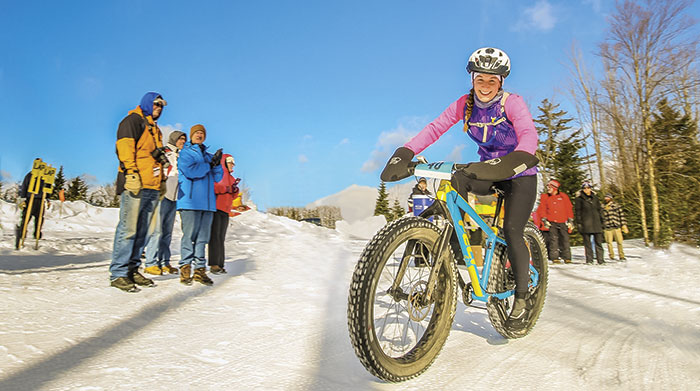
Experience Rangeley
Surrounded by beautiful lakes, and with 10 of Maine’s highest peaks within reach, Rangeley is a world class 4-season town that comes alive with winter events!
The 55 km, mapped trail system at Rangeley Lakes Trail Center offers winter trails for Nordic skiing, snowshoeing, and fat biking. Trails are groomed for skate and classic Nordic skiing. Dedicated single-track trails offer the backwoods experience for snowshoeing and fat biking. There are a variety loops that offer you a choice of trek length, from a quick workout to a day-long outing with a picnic!
Skis, snowshoes, and fat bikes are available for rent. The RLTC staff can offer suggestions for routes to match your ability or available time. When you return, warm up with a variety of choices for soups, hot or cold beverages, and snacks. Check their website for daily trail condition reports and special discount days. The Rangeley Lakes Trail Center is open 9AM to 4PM every day.
Located on Haley Pond is Ecopelagicon, a nature store. Purchase books about the Maine outdoors, maps and camping supplies, as well as crafts, cards and jewelry. Right outside their door is the town cleared ice rink on Haley Pond. Need skates? Free skates are available at Ecopelagicon.
At the end of the day, get some rest at either the newly updated Rangeley Inn or stay lakeside at the Town and Lake Motel and Cottages. Come experience the revival of a landmark, the Rangeley Inn offers a perfect combination of location, ambiance, and comfort. The Town and Lake Motel and Cottages are open year round and located on Rangeley Lake.
Whatever type of outdoor enthusiast you are, this four season vacation destination is sure to pull you back again and again. Ready to help you call this place home is Caryn Dreyfuss of Morton & Furbish Real Estate. From building lots to condos, and lakefront homes to mountain camps, they’ve got something that will tickle your fancy. Come to Rangeley and embrace this winter wonderland. Be sure to bring your camera!


Strong Brewing Company: Beer Geeks to the Core
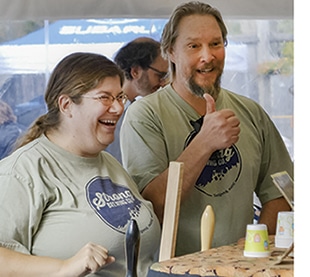
Take a tough Jersey girl with a tender spot for great beer, transplant her to Maine years later, and what do you get? A woman ready to take on the world of craft beer.
Meet Mia Strong, who with her husband Al, owns their tiny craft brewery in Sedgwick, Maine. Opened in 2013, Strong Brewing Company, whose motto is, “Beer geeks to the core…we brew what we like and we like everything,” has already grown in small leaps and bounds, completing a third expansion just this March.
Strong Brewing Company was the product of hard work and crowd-sourcing, including a successful Kickstarter campaign and a Community Supported Brewery, similar to a CSA. While Mia currently runs the business/operations end and Al makes the beer, she will soon train to brew on their new system. One can only wonder what beer styles she has in mind.
I caught up with Mia recently and peppered her with questions about how her love affair with beer began. “My mother was drinking Paulaner when I was in my teens. I snuck one of her beers and liked it. So long  to the Old Milwaukee I pretended to drink with my friends, dumping it out when they weren’t looking. A few years later I discovered Old Rasputin from North Coast. I took a four-pack of it to a party and a guy told me, ‘Girls don’t drink beer like that.’ I had a few choice words for him to set him straight.”
In four years, the Strong Brewing Company has expanded twice, upgrading the brewing equipment, adding a tasting room, partnering with two food trucks and working to attract a third food vendor for summer, 2017.
I ask the million-dollar question: is there room for growth in the craft beer business?
Mia tells me, “I agree with the Brewers Association that we have only 12.2% of the beer market, so there’s plenty of room to grow. The diversity in styles is great for beer drinkers.”
“We’re not afraid to try new recipes and we listen. Last summer, people were asking for a stout. We switched up our production schedule in order to brew one to have on tap.” Mia has two kids, so I wonder what’s on tap at dinner time, for the adults, of course. What beers pair with comfort food like mac and cheese? “Something light, like our California Common Ale called Locomotive.” I’ve had it, and I agree. Goes great with clams and lobster, too.
— Kate Cone is the author of What’s Brewing in New England, (Downeast Books, 2016). She is currently working on a book about her search for her Irish ancestors and the beers they drank. Contact her at kateconewrites@gmail.com

Five Maine Running Groups
Find running camaraderie on the trails and the road
Warm weather brings all the runners out, from the mighty fast marathoners to the easy-going jog-walkers. And while solitary runs on local trails suit plenty of folks just fine, running with a group has perks, too. Running groups are supremely social (which often translates to making new friends), and running with other people supplies a level of motivation that’s hard to summon on our own. Many of Maine’s running groups are free to join, or have a nominal annual membership fee, and most of them run year-round, too (sometimes in snowshoes).
Maine Track Club
Maine Track Club has gathered local runners together since 1979. Open to all level, MTC has groups in several towns, including South Portland, Cape Elizabeth, Gorham, Scarborough, Sabattus, and Yarmouth. They also organize several races a year, and members have access to training clinics and social events. Membership is $25 a year. Mainetrackclub.com
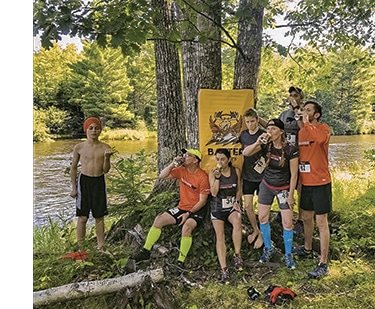
Photo: Emily Higgins-McDevitt
Trail Runners of Midcoast Maine
Trail Runners of Midcoast Maine is a free, year-round trail running group that meets a couple times a week in the Camden area (in warmer months, they usually run the trails at Camden Snow Bowl). Monday Night Dirt is a no-drop group run, which means beginners won’t feel left in the dust, and there are also runs on Wednesday and weekends. Find them on the web or on Facebook.
Old Port Pub Run
Old Port Pub Run is perfect for Portland-area runners who are motivated by post-run beers. The group meets at 6:15 p.m. every Thursday, year-round, at Liquid Riot Bottling Company in Portland. Runs range from 3 to 5 miles, and socializing back at the bar follows. The group is free, but bring money to buy your own beer. www.oldportpubrun.com
Fleet Feet Maine Running
Fleet Feet Maine Running offers run groups its locations in Brunswick and Portland. The $75 fee includes three days of running (Tuesday, Thursday, and Saturday), coaches, a year-long training program, and informational clinics. www.fleetfeetmainerunning.com
Trail Monster Running
Trail Monster Running is for serious trail runners who aren’t shy of rain, mud, and snow. Membership is “paid in the form sweat and blood on the trails,” which means you become an official member by showing up to run and volunteer. How fast you are doesn’t matter – the love of trail running does.
trailmonsterrunning.com
Central Maine Striders
Central Maine Striders in Waterville, established in 1975, connects runners of all levels, from recreational runners to competitive racers. The $15 yearly membership fee is good for the whole household and includes discounts for club races and access to group runs and training programs.
www.centralmainestriders.com
— Text: Shannon Bryan
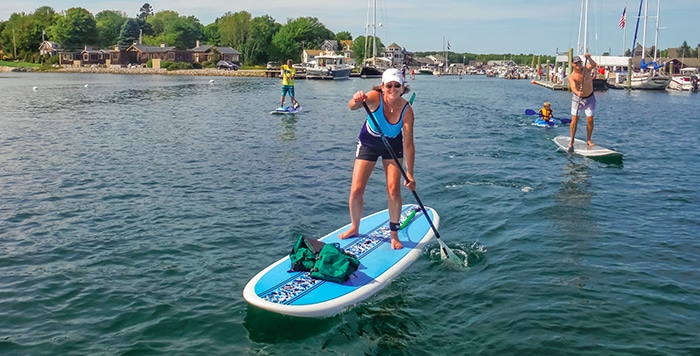
Take It Outside! Outdoor workouts for every level
On the water, on a trail, or planking in the sunshine, sweat-inducing outdoor workouts beat a treadmill any day!
From mountain biking and paddleboarding to outdoor boot camps and yoga in the park, you can find an outdoor activity that’ll have you panting up a storm and loving every minute of it.
If you’re brand-spanking-new to a sport, taking a lesson is always a good way to go. You’ll learn proper form and technique, as well as the best ways to stay safe once you’re out on your own (all things you don’t want to learn the hard way). Plus, that expert guidance will help you learn more quickly (bonus!). If you’ve already got some experience, there are groups, tours and events for you, too.
PADDLEBOARDING
BEGINNER: Paddleboarding looks easy enough to figure out (it’s just standing up, right?), but it doesn’t come naturally to everyone. Start by learning the best techniques for getting upright – which can be harder than it looks – proper paddle form, and safety measure (including wearing a leash and PFD and being aware of weather conditions and tides). Outfitters around the state offer lessons, including Wheels N Waves in Wells, Coastal Maine Kayak in Kennebunk, Portland Paddle in Portland, SOPOSUP in South Portland/Cape Elizabeth, L.L. Bean in Freeport, and Acadia Stand Up Paddleboarding in Bar Harbor, to name a few.
SUP EXPERIENCED: If you’re comfortable standing up on a SUP, then it’s time to start exploring. You can certainly chart your own course on Maine’s waterways, or sign up for a guided tour to places you might not think of. Maine Kayak in New Harbor leads sunset tours in Pemaquid Harbor, Portland Paddle leads tours to Fort Gorges in Casco Bay, and Seaspray Kayaking & Paddleboarding offers downwind ocean paddleboard tours that depart from Hermit Island in Phippsburg and end at Sebasco Harbor Resort (where a restaurant, bar, and outdoor pool await).
To really work yourself out, check out a paddleboard yoga class with Koan Wellness in York, on Lake Androscoggin with Windsurfing Maine, or with an area paddle shop, many of which are offering SUP yoga these days. Maine Sport Outfitters in Rockport offers SUP Fit classes to really work your core and get your heart racing.
MOUNTAIN BIKING
 BEGINNER: Learn the basics with free weekly skills clinics in Portland. Sponsored by the Bicycle Coalition of Maine, the Wednesday evening clinics are perfect for beginners. They alternate each week between novice clinics on the Eastern Prom and beginner to intermediate clinics on the Stroudwater Trail. Sunday River in Newry runs a bike school with 90-minute clinics that include a bike rental and helmet. L.L. Bean in Freeport offers Learn to Mountain Bike courses that include all equipment and instruction.
INTERMEDIATE RIDER: Hit the trails on your own — the New England Mountain Biking Association is a great resource for trails — or join up with a local mountain biking group for some trail togetherness. The Single Track Sisters is a free women’s group that rides regularly on Monday and Wednesday evenings (Mondays are great for beginners, too). NEMBA has several Maine chapters, including in the Carrabassett region, Midcoast, Central Maine, Portland, and Penobscot area. The Green Machine Bike Shop in Norway leads group rides, too. For group rides (all levels welcome) that end with beer, check out the Bikes & Brews events from Gear Works Productions.
GO AFTER IT: Challenge yourself with a mountain bike race such as 12 Hours of Bradbury Mountain in Pownal on September 16. You’ll compete against other area riders, push yourself harder, and have an incredible experience, too.
OUTDOOR WORKOUTS
 BEND & STRETCH: Yoga is splendid for all levels – it’s great for strength, balance, and flexibility. But if you’re looking for an accessible workout that’ll have you inhaling warm summer air (rather than panting for breath), yoga is it. Many studios offer outdoor classes in warmer months. Practice Yoga leads yoga classes on Ogunquit Beach every morning from 7:30-8:30 a.m. The Viewpoint Hotel in York hosts outdoor yoga with views of Nubble Light every Wednesday from 8-9 a.m. In South Portland, Kelly Rich Yoga offers yoga at Bug Light Park every Tuesday 6-7 p.m. and Sundays 10-11 a.m., and Willard Beach Yoga leads classes on Fisherman’s Point. In Portland, Ashley Flowers teaches 6-7 p.m. Wednesday nights at Payson Park. If you like to cuddle some baby goats after your workout, check out yoga at Sunflower Farm in Cumberland.
SERIOUS SWEAT: Outdoor boot camps offer you the chance to sweat your brains out on the beach, on the grass, or up and down the bleacher stairs at your locals sports stadium. These boot camps are open to beginners, too, and offer heart-pounding workouts that’ll leave you exhausted and happy. In Kennebunk, check out Get Out There Fitness for 45-minute workouts at Mother’s and Gooch’s Beaches. Saco Biddeford Bootcamp offers workouts on the beaches of Biddeford Pool on Monday, Wednesday, and Friday, and Portland Sweat Project meets every Wednesday morning for free fitness at various locations around town.
REALLY KILL IT: Sign up for the Ragged Mountain Scuttle at Camden Snow Bowl on September 24.
— Text & Photos: Shannon Bryan

Find your summer bliss in the Rangeley Lakes Region
Maine’s Rangeley Lakes Region includes more than the 10-square-mile lake itself, extending to five other large lakes and hundreds of smaller lakes and ponds. Add rivers and streams, two mountains – Saddleback and The Horn — just east of the lake, and mile after mile of forests. What do you get? A paradise for those who love the great outdoors and all the activities it invites. Fishing, swimming, kayaking, canoeing, hiking, climbing, camping, cycling, wildlife watching or just lazing beside the lake – whatever your summer bliss, you’ll find it here.
Hikers and climbers have their choice of woodland trails or several mountains. Bald Mountain Hiking Trail, between Rangeley and Mooselookmeguntic lakes, climbs to an altitude of 2, 443 feet for 360-degree views over both lakes.
AJ Cycles (207-864-2850) on Maine Street in downtown Rangeley rents and sells Fat Bikes. They are a full-service bike shop, if your own needs a tune-up or repairs. Take a rental from AJ’s to the extensive network of trails at the Rangeley Lakes Trail Center.
Moose Loop Cafe is located on Main Street, at the trailhead to Franklin County’s Moose Loop, a forest trail with mountain climbs and scenic views.

View from Mingo Springs Golf Course
Golfers will appreciate the scenic Mingo Springs Golf Course, a favorite of both beginners and scratch players. Although the course is relatively short, it’s challenging, and birders love it for the variety of species that nest alongside the course.
All the lakes and ponds surrounded by forest makes a prime wildlife habitat, and moose-watching and photography is one of the region’s most popular activities. If roadside “stakeouts” between Rangeley and Eustis — a favorite moose-spotting spot — aren’t enough, take a moose-watching tour with prize-winning moose caller Matt Tinker through Green Farm Guide Service.
Green Farm can also plan and guide day and overnight hiking trips and guided fishing for pickerel, perch, trout or salmon. Their expert fishing guides can help you improve your dry fly casting, too.
With lakes on every side, it’s hard not to spend some time enjoying water sports. Lakeside Park, on Main Street in Rangeley, has a free sandy beach with lifeguards, picnic tables and changing rooms, while Rangeley Lake State Park, on the lake’s south shore, has a beach with lifeguards; it charges a small day-use fee.
To explore the lakes and ponds and enjoy the wildlife that make their homes on the shore, rent a canoe or kayak at Ecopelagicon Kayak Rentals on Pond Street in Rangeley. Single and double kayaks, canoes and standup paddle boards can be rented by the hour, day or week. Ecopelagicon also offers tours and lessons in all three sports.
You can find equipment and clothing for all your water sports and other outdoor activities at Rangeley Region Sports Shop in Rangeley or at Rivers Edge Sports Shop in Oquossoc.
Most guides provide the equipment necessary for their activities. Black Brook Cove Guide Services offers day or half-day salmon and brook trout fishing trips on the famous Rapid and Kennebago rivers, with all equipment included.
The area has plenty more lodging options. The Rangeley Inn and Tavern, overlooking Haley Pond in the center of town, has rooms with lake and mountain views, as well as a farm-to-table dining room.
Rooms at the pet-friendly Town and Lake Motel, are on a beach within easy walking distance of restaurants and shops, have beautiful lakefront views; some have well-equipped kitchenettes. For lakeside rental cabins, contact Russell’s Rentals.
Caryn Dreyfuss Real Estate can help you find your own little spot of heaven in the Rangeley region, whether it’s a cozy cabin in the woods or a family-sized lakeside retreat.
Start the day with an omelet or eggs benedict at The Gingerbread House Restaurant on routes 4 and 17 in Oquossoc or savor their signature crabcakes at dinner on the wrap-around porch. The Red Onion Restaurant in Rangeley is known for pizza but has a long menu of sandwiches, too. Find plenty of take-out options for trail lunches and picnics at family-owned Keep’s Corner Café and Bakery (207 864-2262) on Main Street or at the sandwich deli in the Moose Loop Cafe.
Text: Bobbie Randolph
Saisons with a Twist
Since last spring I’ve had a love affair with saisons. I had always been a casual fan of the earthy, dry saison style, but last year it turned borderline obsessive. Each time I stood in front of a beer cooler, I’d find myself uncontrollably drawn to the saisons’ siren song.
As a long-time homebrewer, when I become smitten with a style of beer, I’m inclined to brew a batch in my kitchen. Homebrewing allows me to get intimate with a beer style, becoming acquainted with its nuances from the inside out.
But like that green-eyed, enigmatic girl at a school dance, the saison intimidated me. Saisons get the heft of their flavor from yeast. The beers I’ve traditionally brewed are hop-forward ales.
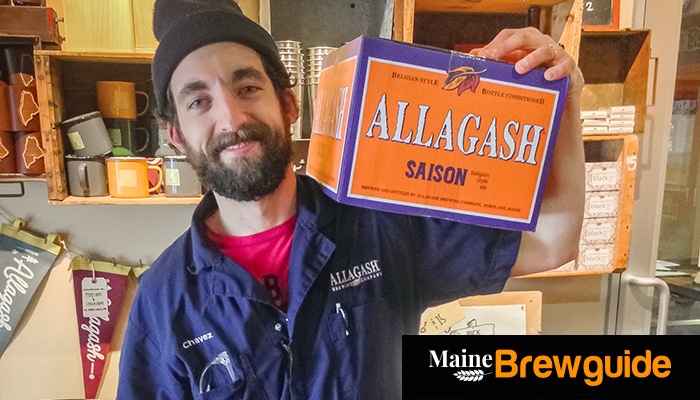
Luckily, two of my favorite saisons are brewed in Maine: Allagash Saison from Allagash and Farmhouse Pale Ale from Oxbow.
On a snowy day in late winter, I sit down with Allagash brewer Patrick Chavanelle at the Industrial Way brewery in Portland to get some tips on how to work with the sexy, if not unruly, saison yeast.
Clad in a one-piece brewing suit, Chavanelle explains that he originally brewed the Allagash Saison as a homebrew beer when he was hired at the brewery. Head brewer, Jason Perkins, liked the homebrew, and the Allagash team spent two years piloting batches before they settled on a final recipe for their dry, citrusy saison.
“The most important part of working with saison yeast is controlling the fermentation temperature,” Chavanelle states.
With most saison yeast strains, a homebrewer can achieve a range of flavors depending on the fermentation temperature.
High fermentation temps, in the mid-eighties for example, bring out spicy, funky flavors from the phenols, though fermenting too high can produce plasticy, band-aid-esque off flavors. Lower fermentation temperatures around seventy degrees bring out fruity flavors. However, if you ferment too low, the yeast will stall and homebrewers won’t get the proper attenuation to produce a dry finish—a vital saison characteristic.
Recognizing the frightened look on my face, Chavanelle assuages my fears by explaining that a fermentation temperature around seventy-five degrees will bring out the spicy, fruity saison flavors I’m looking for.
With growing confidence in my understanding of saison yeast, I contact Tim Adams, head brewer and owner of Oxbow Brewing Company, to help me better wrap my head around hopping a saison.
“You can use as much hops as you’d like, but be careful about when you add them to the boil,” Adams cautions. “The biggest problem you can encounter is making the beer too bitter.”
Adams continues that the longer a hop boils the more bitterness gets extracted from the isomerization of the alpha acids in the hops. When I explain that I’m interested in adding American hops to my saison for lush citrus flavors, he advises I add the majority of my hops in the whirlpool at the end of the boil and in dry-hopping. This advice saves me from making the mistake of over-hopping my wort at the start of the boil.
 I’m now ready for my last stop before homebrewing: Maine Brewing Supply in Portland to consult with homebrewing Zen master Gordon Jones.
When I utter the word saison to Jones, a twinkle appears in his eyes; I know I’m talking to a kindred spirit.
“Saisons are the best style of beer to play with, because you have so many flavor components going on,” Jones states.
Clarifying the type of saison I want to brew, Jones rattles off a half dozen saisons brewed in the U.S. using domestic hops.
During this discussion, the Amarillo hop continually comes up. With bold flavors of oranges and grapefruit, Jones explains that many brewers turn to the Amarillo hop to get a clean, citrus interplay with the funky saison yeast.
Recalling that Tim Adams had mentioned the Centennial hop as a good choice for saisons, Jones and I put together a hop schedule of Amarillo and Centennial hops, saving all the hops for five minutes left in the boil, the whirlpool, and dry-hopping. Eschewing the bittering stages of the boil altogether.
Jones suggests Wyeast 3711 French Saison, a hardworking yeast strain known for its ability to work through residual sugars to create the dry finish I crave.
Keeping the malts simple—six pounds of extract pilsner malts and one pound of crushed wheat—will allow the French saison yeast and the American hops to shine in this homebrew.
My brewing partner, Tim Ebersold, and I head off to brew our saison. Imagine a month-long movie montage of us boiling, steeping, spilling, bottling, and impatiently waiting while Tom Petty sings, “The waiting is the hardest part.”
After five weeks, I wistfully crack open a bottle, and there it is: the spicy, funky aroma of saison yeast. There’s a nice bouquet of hop citrus flavors from the Amarillo and Centennial hops when I sip the saison, but they don’t get in the way of that beautiful French saison yeast. As the warm weather hits New England, brew up a saison and let the dry, fruity flavors accentuate your summer days.
— Text & Photos: Dave Patterson

How to Photograph Whales and Other Elusive Wildlife
In most DSLR cameras there are 4 popular modes where exposure decisions are either fully or partially made for you by the computer in the camera. Those 4 modes are…
Full Auto – Green: where the camera chooses everything for you. You will certainly make a picture, but usually not with the best results possible.
‘P’ or the Program mode: where the camera chooses the exposure for you. Your camera will set the shutter speed and the lens f/stop to make a picture and this is a good all-around mode in which to shoot for everyday photography.
‘Tv’ or ‘S’ is for Time Value or Shutter mode: where you set the shutter speed and the camera assists by selecting the lens aperture appropriately to make a good exposure. A fast shutter speed can be a good option for freezing action to reduce motion blur when shooting moving subjects.
‘A’ or Aperture value: where you choose the lens f/stop or Aperture and the camera assists by selecting the appropriate shutter speed (time) to collect light to make a good exposure. Aperture mode is best for doing still life, portraits and for those times when you want or need to control the depth of field or the selective focus in a scene.
Tricking your camera
There is a fifth way where you can trick most new DSLR cameras to assist with the exposure, which can help you make your best shot.
The Manual mode is usually where you make ALL of the exposure decisions in your camera, including the light sensitivity or ISO. By setting the ISO to Auto you can force your camera to assist with the exposure based on your Shutter and Aperture settings and on the available light in the scene. In Manual mode you can set the shutter speed, to freeze the motion as desired, and set the lens aperture to get the selective focus or depth of field that you want all while letting the camera figure out the proper ISO to make a good exposure.
Here is an example – you are going on a whale watch and want to come back with sharp images, but you are on a moving boat and the subject matter is moving as well. Here’s what you do…
Select Manual mode in your camera and set the shutter speed to a fast setting – 1/1000th to 1/2000th of a second for instance. Most lenses have a sweet spot where their sharpness is the best, usually between f/8 and f/11. Set the aperture in this range favoring f/11 to get the sharpest image from your lens and to also gain more depth of field. Next, set the ISO to ‘Auto’ and let your camera assist by adjusting the light sensitivity accordingly. These settings work best in areas with bright sunlight. In darker scenes, the ISO may be raised too high causing noise in the picture that will manifest as grain. This ‘Auto-Manual’ or ‘Manual-Auto’ technique also works well for photographing birds, surfers, and other moving subjects where you want to have the ability to control the sharpness of the image.
Give it a try the next time you are out photographing and see if it helps you to make your best shot.
— Text and photo: Michael Leonard
Wilderness Camping in Maine
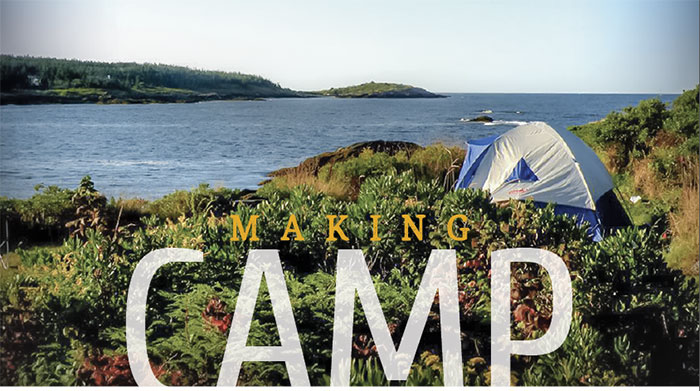
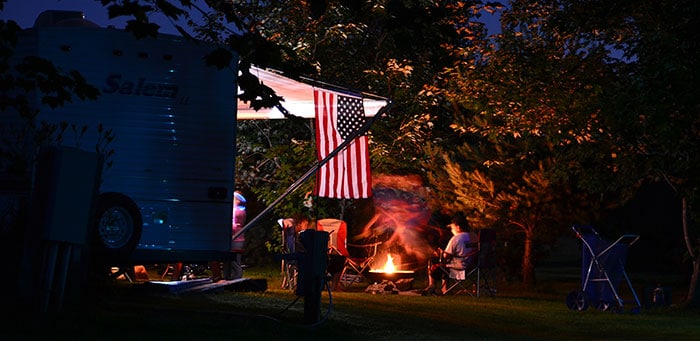
Few things truly say “summer” like the crackling of a campfire as orange light dances around the campsite. The heady scent of the deep forest and the campfire smoke soothes your senses. Thankfully, you don’t have to heave off too far into the wilderness to find a piece of the forest you’ll feel you can truly call your own. These campgrounds will bring you that deep wilderness feel without having to mount a multi-day expedition just to get there.
MIDCOAST
HERMIT ISLAND
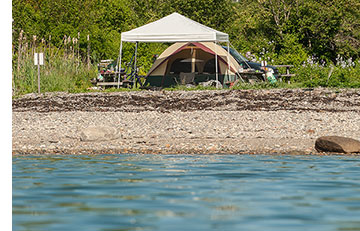
Photo: Carol Savage. carolsavagephotography.com
While indeed an island unto itself, Hermit Island is one you can reach by car over a short narrow causeway. The private campground at Hermit Island has something for everyone, whether you want to be nestled deep in thick evergreen forest on plunked on a windswept ridge or right on the smooth sandy beach. It’s a huge campground with 275 individual sites, but it doesn’t feel huge. When you set up your tent, you’ll still feel like you have a piece of the island to yourself. The preferred areas are Osprey Point and Sunset Lagoon, Joe’s Head and Sand Dune Beach. Make a reservation well in advance and hope for decent weather.
When you’re at Hermit Island for a few days, treat yourself with a side trip to Popham Beach. This spectacularly scenic smooth sand beach is shaped like two huge crescents, with a large jetty in the middle that’s great for climbing on and just hanging out to be with the ocean for a few hours.
THE HIGHLANDS
CHIMNEY POND IN BAXTER STATE PARK
Of all the campgrounds and campsites throughout Baxter State Park, you’d be hard pressed to find one that feels more magical. You are right in the cradle of Katahdin, and on the shores of Chimney Pond. It truly doesn’t get much better than this. Gaze around the scenery and you may feel as if you’ve been transported to Middle Earth. The gray granite spires of Katahdin loom ominously around you—at once inviting and daring you to climb.
Pack light, as you will have to hike in—it’s 3.3 miles from the Roaring Brook Campground. There are nine two-person lean-tos and a 10 person bunkhouse, so you won’t need your tent. This is one of two back country campgrounds within Baxter State Park and is quite popular. Reserve well in advance, and be respectful of the rules. The rangers take very seriously Percival Baxter’s doctrine of the park being a “wilderness preserve first, recreation resource second.”
MOOSEHEAD

Lily Bay on Moosehead Lake. Leah LaRoche
LILY BAY STATE PARK
Lily Bay State Park is another wild and remote park and that provides the feeling of island camping on the shores of Moosehead Lake without having to load up a canoe or kayak. There are plenty of remote feeling lakeside sites, especially on the Dunn Point side of the park. Most sites must be reserved, but several are first come, first served. Do yourself a favor and reserve a waterfront site. These primo sites fill up fast in the summer. If the Dunn Point side is full, don’t despair. Go for the peninsula of sites 33 through 38 on the Rowell Cove side. This little group of sites is among the best at Lily Bay.
The sites deeper in the woods are also spectacular, but since you’re right on the shores of Moosehead Lake, your campsite might as well be there too. And if you’re truly daring, part Inuit, or have a high pain tolerance, you can even take a dip in the cool waters of Moosehead Lake. It will truly take your breath away, even on the hottest summer day.
WESTERN LAKES
RANGELEY LAKE STATE PARK
In the right moments, the stillness, the darkness and the quiet at Rangeley State Park are absolute. The still may only be punctuated by loons checking in from alternate ends of the lake before they turn in for the night. Rangeley Lake State Park has 50 sites spread throughout the dense forest. Aim for one near the shore of the lake, especially sites 11, 13, 15, 17, 19, 21 and 23. If those are already full, fear not. You’ll never be that far from the lake either way. Try for one of the sites set along the outside of the campground loop road, as those typically have a bit more forest separating the individual sites. At night, when the campfire is crackling, all you’ll see is your immediate circle bathed in the orange light of the campfire. The surrounding forest will be shrouded in impenetrable darkness and you’ll feel like you have the forest and the night to yourself.
DOWNEAST AND ACADIA
COBSCOOK BAY STATE PARK
Cobscook Bay State Park has an embarrassment of riches when it comes to oceanfront campsites. Try to get a site on the Cobscook Point peninsula with sites 56, 57, 59, and 62. These spectacular sites are truly set off on their own. This is another spot where you can get that remote island camping feel, even though if you run out of Cheez-Its, your vehicle is parked only 30 yards away.
One cool thing about camping Cobscook Bay State Park is clamming out on the mud flats. You can venture out there at extreme low tide and pick yourself a peck (about two gallons or 15 pounds) of clams. Be mindful of the incoming tide though. When the tide turns and comes in, it comes in quite rapidly and the tidal range averages 20 to 24 feet. Getting trapped on the mud flats can be inconvenient; it can even be dangerous. Cobscook is actually the Passamaquoddy term for “boiling tides.” Back at your campsite, you won’t have any fresher clams than those you just dug up and grilled over your fire.
Text: Lafe Low
Summer Camping Gear Wish List

FOR THE GEARHEAD:
Outdoor Gear Lab gives the Anker15W Foldable Dual Port Solar Panel the best marks for 2017 for charging your phone and music in the wilderness. It’s lightweight, durable and competitively priced at $49.99.

FOR THE GLAMPER:
Hydro Hammock is one of the most buzzed about outdoor accessories in the last two years. This hot tub hammock holds up to 750 pounds of body weight and water, with a water heater that offers serious relaxation. It ain’t cheap at $1892 for both hammock and water heater, but it looks like pure bliss.
FOR THE PRIMITIVE CAMPER:
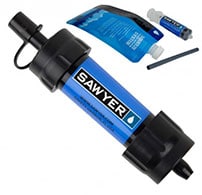
The Sawyer Mini is an award-winning 2 ounce water purifier which filters up to 100,000 gallons of water coming in at an affordable $19.99.
FOR THE FIRE RING FOODIE:
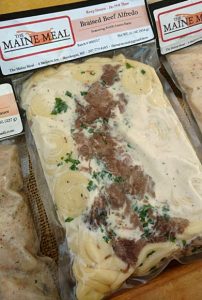
The Maine Meal are gourmet frozen prepared meals made by Skowhegan couple Mark and Kelly LaCasse ranging from lobster, sea scallops,beef and chicken, along with side dishes of vegetables, soups, pasta, potatoes and grain dishes. $30-35 feeds two people.
Text: Kay Stephens

5 Can’t Miss Hikes Downeast
One of the most rewarding aspects of hiking Downeast is the chance to get off the beaten path. Downeast hikes offer the same spectacular views as their more well-known counterparts with the bonus being solitude. Here are five great places to explore hiking trails.

A family makes its way along the Hollingsworth Trail in Petit Manan National Wildlife Refuge in Steuben
Great Wass Island
The Great Wass Island Preserve in Beals offers several hiking trails with some of the best views Downeast. Trails take hikers both through the woods and along the rocky coast.
The Little Cape Point trail (2.2 miles) intersects with the Mud Hole Trail (2.3 miles) at Little Cape Point to make a nice 4.5-mile loop. The terrain is uneven and difficult and hikers should use caution, especially in bad weather.
Start by taking Little Cape Point trail through the woods. You will reach the ocean shortly before arriving at the point, where you pick up the Mud Hole Trail. Mud Hole runs along the shore for about a mile before cutting back through the woods to the trailhead. One of its best features is a view of Moose Peak Lighthouse, which is located across Eastern Bay on Mistake Island.
Petit Manan Wildlife Refuge
The Petit Manan Wildlife Refuge in Steuben offers two trails — Birch Point and Hollingsworth.
The 2.2-mile Birch Point Trail begins in an open blueberry field and takes hikers into the woods. The smooth and wide trail, which is easy for hikers of all ages, provides a number of scenic stops featuring benches and interpretive signs. One of the best views is Lobster Point, where Adirondack chairs in the woods look out over the bay and rocky shore.
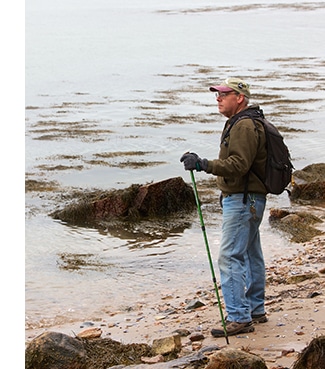
The Trails at Eagle Hill Institute allow hikers direct access to the water.
The 1.5-mile Hollingsworth Trail starts in an open field and takes hikers over a slightly more challenging terrain to a rocky granite beach at Chair Pond where they can enjoy a rest on Adirondack chairs. Explore the beach area, looking for shells, interesting rocks and even old lobster buoys that have washed upon shore. Pigeon Hill Bay and the lighthouse on Petit Manan Island are visible from the trail.
Eagle Hill Institute
Eagle Hill offers a network of six intersecting trails, which range in length and difficulty. Just a 10-minute walk from the main building is a scenic overlook offering views of Gouldsboro Bay, including Schoodic Head and Cadillac Mountain in Acadia National Park. Other trails take hikers through the woods, through blueberry barrens and along the coast of Dyer Bay.
Few people seem to know about this hidden gem. Hikers will enjoy solitude and the feeling of being alone on a private preserve. Eagle Hill also offers camping and has an on-site restaurant that is open in the summer. The institute also offers a variety of programs year-round, including concerts, workshops, seminars and presentations.
Quoddy Head State Park
Of course, the obvious attraction here is the West Quoddy Head Light, the easternmost lighthouse in the U.S. However, hikers can head off the beaten path right from the lighthouse to a series of trails not usually explored by lighthouse visitors. Most notable is the Coastal Trail which takes visitors along the shore from a high, rocky vantage point. At 4 miles round trip, this is the park’s longest trail. It shows off the cliffs from a wooded vantage point with periodic overlooks where views can be appreciated without obstruction.

A group of seagulls sits on the rocky shore along the Hollingsworth Trail in Petit Manan National Wildlife Refuge in Steuben
The other trails offer the hiker the chance to explore bogs and forests full of mosses and lichens. A variety of birds, from seagulls to bald eagles can also be seen along this and other trails. The park also features spots for picnicking.
Pigeon Hill Preserve
The Pigeon Hill Preserve offers 1.8 miles of trails. Hikers can climb to the summit to see views of the coast and pick blueberries in season. Other trails take hikers to the defunct silver mine.
At 317 feet above sea level, Pigeon Hill is the highest point along the coast in Washington County. The top of Pigeon Hill was used in the original “Eastern Oblique Arc” survey when the US government surveyed the eastern coast of the United States. From the top looking west Mount Desert Island can be seen, to the south Petit Manan Point and lighthouse can be viewed.
GETTING THERE
Great Wass Island Preserve, run by the Nature Conservancy, features 1,576 acres in Beals, Washington County. Described by its website as the “spectacular gem of Downeast Maine,” it is located off Route 187, accessible from Route 1 in Jonesboro.
Petit Manan Wildlife Refuge does not have its own website, but information on the trails is available on Maine Trailfinder: Birch Point trail / Hollingsworth trail.
Eagle Hill Institute is a nonprofit organization aimed at promoting natural history and the arts. Information on the hiking trails is accessible here.
Quoddy Head State Park is located four miles off Route 189 in Lubec and features 541 acres of forest and bog. Additional information on trails, including maps and day-use fees, can be accessed online or by calling 207-733-0911. The lighthouse, located adjacent to the park, is run by the West Quoddy Head Lightkeepers Association. The visitor center is open daily from Memorial Day to Oct. 15. For more information, call 207-733-2180 or email info@westquoddy.com.
Pigeon Hill Preserve is located off Pigeon Hill Road, just off Route 1 south of Milbridge. For more information visit downeastcoastalconservancy.org.
Text & Photos: Johanna S. Billings
In addition to being an avid hiker, Johanna is a national award-winning writer and photographer based in Steuben, Washington County. Her website is jsbillingsphoto.com.

Maine vacations built specifically around breweries
In recent years, I’ve gotten into the habit of counting license plates at big beer releases. Specifically, I’ve been checking out how many out-of-state plates are mixed in among the Mainers seeing what’s new from their local brewers. More and more, the number of people “from away” dwarfs the locals. There’s always a reliable contingent of Massachusetts folks, followed closely by flannelled Vermonters and our neighbors from New Hampshire. But Maine beer is drawing drivers from further and further away. On release days at Allagash and Bissell Brothers, you’ll increasingly see people coming from as far as New York, Pennsylvania and even Virginia.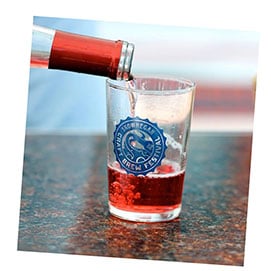
Beer tourism — that is, trips and vacations with an itinerary built specifically around breweries — is booming in Maine and around the country. The Brewer’s Association (the trade association for small and independent American brewers) estimates that about ten million people visited craft breweries last year, and that number is only rising. With over 90 breweries operating in the state, and one of the highest concentrations of breweries per-capita in the country, Maine is at the forefront of the world of “beercations.”
“During 2016, 85% of the 5,300 guests on board came from places other than Maine,” says Don Littlefield, General Manager of the craft beer tour company the Maine Brew Bus. And these visitors weren’t here just to try Maine beer, but to take it home. “Over a 12-month period, our tour guests purchased over $50,000 in additional spending for beer and merchandise to bring home.”
These purchases of beer (either for consumption or to-go) at breweries are big business — the Brewer’s Association reports that about 7% of total brewery beer sales are made at a brewery or in a tasting room. Littlefield suspects the rate is much higher in Maine, with “75% or more of sales” for some brewers coming from direct interaction with customers at their breweries.
BEST BEER STORES
[ezcol_1third]
Bangor Wine & Cheese
Belfast Co-op
Bier Cellar
Bootleggers
Bow Street Market
Global Beverage Warehouse
[/ezcol_1third] [ezcol_1third]
Good Beer Store
Madden Beverage
Maine Beer and Beverage
Oak Hill Beverage
Old Port Spirits & Cigars
Rising Tide[/ezcol_1third] [ezcol_1third_end]
Rockland Food Service
Ron’s Market
RSVP
State Street Wine Shop
Tully’s Beer and Wine
The Vault[/ezcol_1third_end]
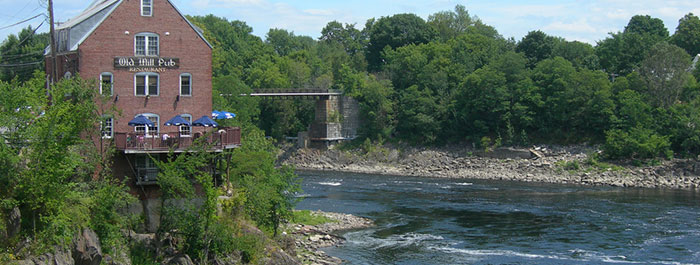
Maine is called “Vacationland” for a reason — tourism is practically the state’s raison d’etre — and has been part of the state’s brewing landscape since the first lobster-branded phial of Geary’s Pale Ale rolled off the bottling line in the ’80s.
On top of this, the brewers of the Pine Tree State are making great beer. Beer so great, in fact, that it’s highly sought after outside of our borders. And with the majority of the state’s brewers only distributing within Maine (and many distributing themselves, only within a few dozen miles of the brewery), demand for Maine-made beer straight from the source is at an all-time high.
“Visitors from out-of-state have been a big part of the people who walk into our tasting room since we’ve opened, and it has only grown since then,” says Tina Bonney, Business Manager at Foundation Brewing Company. “It’s great to see interest in Maine beer grow, not only because we love to share what makes the beer scene here great, but it’s also a chance to share other cool things that are going on here, and why we love calling Maine home.”
While demand is peaking now, it’s not a new story. For years, the largest beer sites online (Ratebeer, BeerAdvocate, and Reddit’s r/beer) have hosted forums for beer-lovers looking to share their local beer. If you’ve ever looked on these sites, or even on Facebook and social media posts, you’ll see the popular acronyms FT (“For Trade”) and ISO (“In Search Of”) floating around every local beer release.
In the early 2000s, Bar Harbor Brewing’s Cadillac Mountain Stout was among the most highly sought-after beers from Maine. The dry stout, voted best stout in the world in the World Beer Championships in 1995, topped plenty of “best beer” lists and turned lots of people onto Maine beer. Also in high demand at the time was Shipyard Brewing Company’s Pumpkinhead, a divisive spiced beer that had devoted fans willing to go to great lengths to get their favorite seasonal beer as the days got shorter. Demand also rose for Allagash Brewing Company’s Belgian-style brews, particularly after 2010 as they began releasing small-batch beers brewed in their Coolship (a broad, open vessel used to cool spontaneously fermented sour beers). The Coolship beers age particularly well, and Coolship Resurgam, Coolship Red, Coolship Cerise, and Coolship Balaton, among others, remain in high demand by beer-lovers around the country.
In recent years, the fervor over beer releases has shifted in a hoppier direction. While bold stouts still demand some attention (Rising Tide Brewing Company’s Nikita and Tributary Brewing Company’s Mott The Lesser are two such examples), IPAs, Double IPAs, and cloudy “New England IPAs” draw hundreds of visitors to releases. Foundation’s Epiphany IPA and Maine Beer Company’s Dinner Double IPA both draw massive crowds at each release, creating snaking lines of visitors down Industrial Way and Route 1. Demand for Bissell Brothers’ Substance has been astronomical since they started brewing, but every new release from the brewery draws scads of people to their spot-on Thompson’s Point. The brewery releases a schedule of can releases seasonally, and there seems to be a line no matter the release.
In addition to the demand seen at Maine’s breweries and taprooms, Maine beer retailers see visitors looking to bring home local beer (or trade it with friends near and far). “When we wrote our business plan in 2011, we never foresaw how big beer tourism would be to our business,” says Greg Norton, owner of the state’s best beer store, Portland’s Bier Cellar. “Each year we see increasing numbers of out-of-staters coming in to Maine … It’s been amazing to see how much beer that has gone from our shop to other states and even countries.”
Norton has fostered a good relationship with local brewers, and his shop is a go-to spot for new releases from many Maine brewers, including the aforementioned Bissell Brothers, Foundation, and Allagash. He also advocates for other local beer that doesn’t have quite as much hype behind it. “I generally try to steer them to great examples of styles that may fly under their radar as well as crowd pleasing beers that are pretty universally loved. If it’s summer time, a nice Weiss beer or lager, in winter a porter or stout.”
Outside of Portland, beer stores represent both the greater Maine beer scene and their local brewers, many of whom might not be available in the Forest City. A stop at Tully Beer and Wine in Wells can get you beer from tiny Theory Brewing Company, for example, and Ron’s Market in Farmington carries growlers from local Tumbledown Brewing Company. Bottle shops in the expanding Bangor/Orono beer scene, like Bangor Wine and Cheese, carry bottles, cans and growlers that never make it to Southern Maine’s shelves.
Looking to enter the wild, wooly world of beer trading?
Be advised that shipping through the U.S. Postal Service is a strict no-no, while using carriers like UPS and FedEx is a bit more of a gray area. Forums on the popular beer sites are a great place not only to find trading partners, but also for advice on how best to package and ship your beer. Some bottle shops are also helpful, as sources for bottle shipping containers if nothing else. The short answer? Pack carefully, throw in some extra favorites, and don’t be a jerk. Use trading as an opportunity to share local favorites and receive the same from someone. If nothing else, think of it as a boxed-up beercation.
— Text: Josh Christie
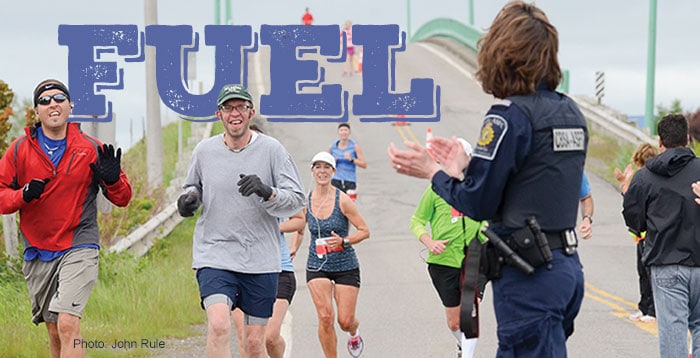
Fuel: Nutrition Guide for Runners
We spoke with nutritionist and running coach Tara Whiton of Fleet Feet Sports to get answers to some common questions athletes have as they get into their training routines. This is Tara’s Nutrition Guide for Runners — check out these important tips to make sure you are on track to meet your goals.
What are some common mistakes runners make with nutrition?
Rewarding yourself with “treats” or very large meals simply because you’ve completed a run is a common mistake. It’s okay to treat yourself once in a while, but remember what your goals are to keep things in check. Beginning runners tend to overestimate their calorie expenditure. In reality we only burn about 100 calories/mile no matter how fast we run.
Eating lots of carbs is another common error. While eating carbs is definitely important for running, runners still need to eat a balanced diet just like everyone else. Lean protein for muscle building and repair, healthy fats (like monounsaturated and omega-3’s), fruits & vegetables for vitamins, minerals and antioxidants. A balanced diet is important for fueling performance and recovering for the next exercise session.
When and how much should I eat before a 30-minute run?
If you are running in the morning after waking you don’t necessarily even need to eat. Later in the day, the general rule of thumb is to eat just a small snack (200 calories) about 1.5-2 hours before the run.
What are the best pre-run foods?
Carbohydrates that are easier to digest along with a little fat and/or protein (to help stabilize blood sugars and keep you feeling satiated). Some examples: banana w/nut butter, 5-6 crackers with nut butter, 5-6 crackers and a couple small pieces of cheese. For those on the go and need of a “convenience snack,” have 1 serving of Clif Shot Bloks, a gel, or a small glass of Gatorade, 30 minutes before run.
How much should you eat before a 60-minute run?
As with a 30-minute run, eat a small snack of around 200-300 calories, keeping in mind that caloric needs are dependent on body size and how fit you are.

Photo: Kevin Morris
What do you need to bring on a long run?
Liquids are the most important thing. Bring water plus electrolytes (like Nuun tablets) to replace electrolytes lost in sweat (primarily sodium and some potassium). Electrolytes also help to move carbohydrates from the small intestine into to the blood stream where they are needed. bring liquids in a handheld water bottle, hydration belt, or hydration pack. Nutrition options should be focused on carbohydrates. Convenient carbohydrates to bring with you are gels and chews.
What nutritional supplements do you recommend?
At Fleet Feet of Maine, we carry GU, Hammer, Clif, Huma, Nuun, Bonk Breaker, Picky Bars and Honey Stinger. Within those brands are several different nutrition forms: gels, chews, electrolyte drinks, recovery.
What about hydration and electrolyte replacement?
Rehydrating with water plus electrolytes is vital to prevent hyponatremia. Hyponatremia can occur by drinking too much water without replacing electrolytes. Drinking only water, you dilute your blood sodium levels, and this can be deadly! This is only a concern in very hot conditions and longer/more intense races.
Drinking electrolytes can also help move carbohydrates ingested out of your small intestine and into the blood steam (so will help prevent that sloshing feeling) AND can help prevent that nauseous feeling that many people experience after a long run. If feeling that way, drink a glass of electrolytes post-run.
What are the best food and drink choices after a moderate run?
Post run it’s important to eat something within the first 30 minutes after exercise (preferably some carbohydrates and liquid). If you can’t stomach it, try to suck down some Gatorade (carbs, liquid + electrolytes). Within the hour, try to consume a small meal consisting of carbohydrates, protein, and some fat…a well-rounded meal. Some examples might be a piece of toast with peanut butter and banana and 2 eggs, a fruit smoothie with some protein powder, yogurt with fruit and granola…etc.
What about having a beer or two after a race or running?
I think having a beer or two is just fine. Beer is only dehydrating if you drink a lot of it, but everything in moderation of course! You are consuming liquid + carbs + B vitamins. Also, if not just for mental enjoyment!
Why are training groups successful in furthering runner’s abilities and goals?
I think training groups are successful from the motivational and accountability stand point. We have friendly coaches and great people who attend our groups. They are very high energy and I think that runner’s typically thrive in this type of supportive environment! People make friends and find running buddies through our groups and we see them return year after year! In a few words: High energy, fun, supportive, motivational!
— Tara Whiton has her Master’s (MS) in Exercise Physiology & Nutrition, is an ACSM Certified Exercise Physiologist, and a running coach. Tara is the Director of Social Media & Communications, and Run Coach at Fleet Feet Maine Running. She is fond of trail races, particularly the 50K as well as short, steep uphill running races. On the road her preferred distance is the half-marathon.

Distilling in Maine: Ingenuity, Craft, and History
It’s mid-afternoon on a Saturday and I’m in an up-and-coming industrial neighborhood in one of Maine’s coastal towns, enjoying a drink. It’s Maine Craft Distilling’s take on a Moscow Mule, served with their spiced Ration Rum, ginger beer, and lime juice. Or perhaps it’s peppery Gunpowder Rye from New England Distilling, served straight up along with a tour of the distillery. I could be in Biddeford’s Pepperell Mill sipping a Bimini Special—a refreshing tonic made with Round Turn Distilling’s Bimini Gin, coconut water, lime juice, and a dash of bitters. The spirits may vary, but one thing is consistent: these craft distilleries are helping to bring life back to once-neglected industrial spaces as part of a resurgence of distilling in Maine that hasn’t been this robust since before Prohibition.
Craft distilleries and their accompanying tasting rooms are following in the well-trod steps of craft breweries. Fifteen distilleries have opened in Maine in the last 11 years, wrestling consumers’ attention away from national brands with carefully crafted, often locally-sourced products in a wide array of styles. Like breweries, the forerunners of the industry worked to change unfavorable laws leftover from the 1930s for their businesses to thrive. And it’s working—as regulations become friendlier to small businesses and the public’s thirst for craft beverages grows, more and more distilleries are firing up their stills and slinging drinks across the tasting room bar.
Distilling in Maine was actually outlawed for the longest period of time in the country—from the passage of the so-called Maine Law in 1851 until the repeal of Prohibition in 1933—a total of 82 years. It should follow then that near every distillery in Maine gives a nod to history by revitalizing forgotten spaces. Distillers work in once-abandoned mills and warehouses in Portland, Brewer, Biddeford and in renovated barns in York, Freeport, Union, and Newcastle. They create spirits that honor our state’s rich history of shipyards, working waterfronts, and agriculture in these spaces made relevant once again.
Of course, no one narrative captures the wide variety within Maine’s craft distilling industry. The men and women behind the stills produce unique spirits using technology that was first discovered in Medieval times, but given a 21st century twist. Unwanted potatoes become gin and vodka at Maine Distilleries; Split Rock Distilling ferments and distills locally-grown organic grains into vodka and bourbon. Several distilleries use molasses to make a number of rums as varied as those from the Caribbean Islands, and gins are flavored with unique botanicals like chamomile, rose petals, and naturally, blueberries. There’s a Maine-made spirit for everyone from fruity mixed drink lovers to serious whiskey aficionados.
As the Maine craft distilling industry grows, so does the average drinker’s knowledge of spirits. Bespoke cocktail menus featuring bitters, amaros, egg white-topped drinks, and housemade ingredients have helped turn many average bar-goers into a knowledgeable and discerning consumers. Others are simply happy to try something new that tastes good, and many are looking to connect with the story behind the drink. As a result, the last few years have seen a rise in the popularity of events and groups that offer drinks with a side of education.
The Portland Spirits Society (of which I am the founder) hosts ladies-only educational events about different styles of liquor. We’ve learned about everything from tequila and Scotch to what kind of whiskey pairs well with chocolate. Briana Volk, owner of the Portland cocktail bar Portland Hunt + Alpine Club, coordinates the New England Cocktail Conference annually, a multi-day event for industry professionals and the public. The conference’s events in years past ranged from tiki drinks 101 to a “grandpa drinks”-themed retro dinner.
A natural extension of the farm-to-table ethos that has gripped our nation’s food, craft distilling has what’s missing from those ubiquitous national brands: a unique sense of place. People want a drink with a story, and the ingenuity and craft that has long characterized the makers of our state fills every bottle. So next time you order a drink at a bar, ask what’s local, and listen for the unique story that only a Maine-made spirit can tell.
— Kate McCarty is a food and drink writer living in Portland, Maine. She has written two books, including Distilled in Maine: A History of Libations, Temperance, and Craft Spirits. Find more of her writing at blueberryfiles.com.

Brewed Awakenings: The Fusion of Coffee and Beer
When you think of the words “Maine,” “coffee,” and “alcohol,” your mind probably goes to Allen’s Coffee Brandy. The ubiquitous brown liquor is practically synonymous with Maine, where it’s been the best-selling spirit in the state for over twenty years. In recent years, Allen’s annually sells over a million bottles – nearly one for every resident of the state.
However, Mainers would be wise to marry coffee and alcohol with another libation – craft beer. Brewers in Maine, like those all over the country, have been incorporating coffee into their brews to delicious effect. And if you’re not a beer drinker, coffee beers can be a great introduction.

Photo: Josh Christie
In the world of commercially-brewed beer, fusion of coffee and ale is a relatively new development. As recently as the mid-90s, the first coffee beers were met with resistance from the Bureau of Alcohol, Tobacco and Firearms, who cited coffee as not being an approved additive for beer. Thankfully, the humble coffee bean survived this threat, and now features prominently beers that vary wildly in style and flavor.
Hops’ and grains’ characteristics in beer vary wildly based on where they’re from and how they’re roasted. In the same way, coffee beans can create a rainbow of different flavors and aromas in beer. A coffee bean can add notes that range from floral and fruity, to smokey, to brown sugar sweet. A favorite early-morning activity of mine is stopping into Speckled Ax in Portland and looking over the flavor descriptions for their different coffees. Coffee has a bounty of descriptors, and the list could put sommeliers to shame.
Coffee is added to beer in a variety of different ways. Sometimes, grounds are steeped in water used to brew a batch of beer for a couple days, then blended into the beer during primary fermentation. Other beers call for adding similarly steeped water directly into the brite tank, where the beer is conditioned after primary fermentation. Still others add brewed coffee just before the beer is bottled and sent off to market. Each method imparts coffee characteristics in different ways, in the same way different methods of brewing coffee result in a different cup of joe. And that can all take a backseat to how much coffee is used, which can mean the difference between subtle coffee notes and a beer that tastes like a latte.
The majority of coffee beers on Maine brewers’ taps are stouts and porters, which makes sense. Those are styles that already have the bitter, roast flavors that many people associate with coffee. The addition of coffee simply accentuates and amplifies them.
The coffee-beer connection is also a chance for brewers to collaborate with local coffee roasters, craftsmen and women who work in an environment not dissimilar from a craft brewery. Even when they aren’t working together directly, the use of locally-roasted coffee drives business through the doors of these Maine producers. The superhero team-up has led to great beers like Waypoint (from Rising Tide and Tandem Coffee), Joe Stout (Bag and Kettle and Carrabassett Coffee), Jolly Woodsman (Banded Horn and Speckled Ax), Happy Dog (Marshall Wharf and Green Tree Coffee), and Mr. Grumpy Pants (Norway Brewing and Coffee By Design).
In addition to offerings that are brewed first and foremost as coffee beers, a number of Maine brewers have won over drinkers with coffee-infused versions of their regular lineups. Foundation’s Burnside, already a sweet and nutty brown ale, takes on a deep coffee complexity when infused with coffee. Loads of other local brews – like Barreled Souls Quaker State, Austin Street Six Grain, Oxbow Townline Porter, and Saco River Old Course, to name just a few – tinker with their darker beers by adding brewed coffee or roasted coffee beans before pouring.
While the marriage of coffee and dark beers feels natural, brewers have discovered that java can be added to other styles with surprising – and impressive – results. Peak Organic’s Espresso Amber, which debuted in 2008, combines organic, fair-trade espresso with the toasty malt and slightly fruity flavors of an amber ale. Rather than overpower the beer, the coffee adds rich, roasty notes and a whiff of coffee in the nose.
Limerick’s Gneiss Brewing occasionally adds cold brew concentrate to Delta, a Dunkelweizen (a dark wheat, German-style beer). The result brings rich, roast coffee flavor to the bread and banana notes of a dunkel, creating a complex and unique beer. Strong Brewing also brews a dunkel with coffee, their 44 Kaffee Weisse. The legendary brewers at Allagash created James Bean by infusing a bourbon barrel aged, Belgian-style strong ale with cold press coffee from Speckled Ax. It all comes together in a beer bursting with caramel, coffee, bourbon, and berry flavors.
Maine’s brewing scene even has a limited edition brew that pays tribute to the infamous Allen’s Coffee Brandy. Since 2013, Ellen’s Coffee Stout has been brewed by Bar Harbor’s Atlantic Brewing Company. Coffee from Crooked Porch Coffee, milk sugar, and Madagascar vanilla make for a sweet and creamy stout that recalls the milk-and-brandy cocktail favored by Allen’s biggest fans.
Text: Josh Christie

PLUS:
Maine Brew & Bev Guide
Maine Health & Wellness GuideAND:
The Activity Maine Newsletter
Adventure, news, reviews, wellness, and craft beer, emailed twice each month!

-


SUBSCRIBE | BREW & BEV | WELLNESS | CALENDAR | VIDEOS | PARTNERS | PREVIOUS PUBLICATIONS | SUBMISSIONS | NEWSLETTERActivity Maine
9 Susan’s Way, Windham, Maine 04062
Tel: 207-671-7230
Email: stan@activitymaine.com