

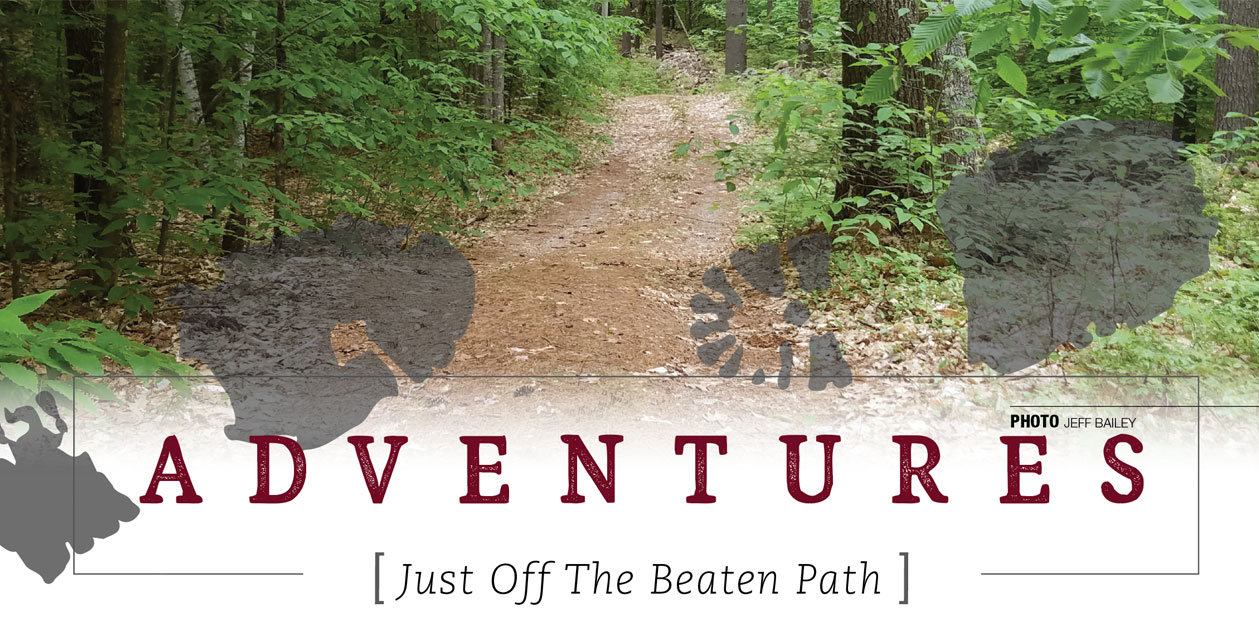
Explore the Maine Coast Way Down East
Coastal Washington County features some of Maine’s most spectacular scenery, as well as some great fun adventures.
Driving Down East on Route 1 from the south, your first stop will be just off Route 1 on Route 187 which will take you into the pretty little town of Jonesport and Beals Island. This small hamlet of 1370 is a fishing and lobster community that was settled in the years preceding the Revolutionary War. It was originally a part of Jonesboro under a grant given to John Jones and other settlers by the Massachusetts General Court. On February 3, 1832, it was separated from Jonesboro and incorporated as Jones’ Port. The main village of Jonesport is located on the Moosebec Reach and Indian River. A bridge across the Moosebec Reach joins Jonesport with Beals Island.
The United States Coast Guard has maintained a station in Jonesport since 1967. Another local landmark is the stately Sawyer Memorial Congregational Church which was dedicated on June 7, 1887.
If you are ready for an adventurous hike you will find it just across the bridge from Jonesport at the Great Wass Archipalego. Here you will find a winding and moderately challenging trail. As you enjoy your trek along this pristine coastal landscape take the time to relax on a rock and take in the ocean view. Be sure and take photos of this piece of Maine’s hidden coastline. Upon finishing your hike you will head back across the bridge and again pick up route 187 which will loop you back to Route 1 in Jonesboro. Proceed north on Route 1 in Jonesboro until you see on your right the sign Roque Bluffs Road, which you will turn on and follow for 5 miles to a T-intersection, where you will turn right still on Roque Bluffs Road and continue to Schoppee Point which will lead you directly to Roque Bluffs State Park.
The diverse habitats of the park provide an abundant support system for wildlife. Bird watching can be enjoyed year-round. Bald eagles are frequently seen, as are many waterfowl, including Redhead and Gadwell ducks; while pipers and interesting species of gulls can be seen along the beach during the summer months.
A beautiful half mile crescent sand and pebble beach along Englishman Bay offers bracing saltwater swims on warm summer days and in the park across the road from the ocean you can swim in the warmer fresh water of Simpson Pond. The park offers changing rooms, picnic and children play areas adjoining the parking areas.
There are five hiking trails offering varied lengths, from 1 to 2 miles. The Pond Cove Trail is a 2 mile hike over largely flat terrain through meadows and offers a scenic view over Pond Cove.
To continue your fun adventure just off the beaten path return to your car and turn left out of the parking area onto Schoppee Point, you will pass through the small village of Roque Bluffs where you will again pick up Roque Bluffs Road to the north for 8 miles where it loops back onto Route1. You will go north on Route 1 about a mile into Machias, the Shire Town of Washington County. Before the arrival of Europeans to the Machias area, Native Americans of various tribes made an annual September pilgrimage to the shores of the Machias River at Clarks Point. Here have been found extensive clam heaps, providing evidence of their gatherings. It is believed that the Norsemen were most likely the first Europeans to arrive in America’s most eastern conclave. The community has a rich history having been successfully settled in 1763.
In 1775, the Burnham Tavern was the meeting place of the settlers to enjoy a drink, when news of the battles of Lexington and Concord reached them they raised a liberty pole on the village green. On June 12, 1775 a group of 40 locals under the command of Jeremiah O’Brien went out into Machias Bay on the Unity and defeated the British ship Margararetta which became known as the Lexington Battle of the Sea.
In 1784, Machias was incorporated as a town by the Massachusetts General Court. The town has a rich history and is a perfect spot to rest on your adventure as Machias is blessed with both great accommodations and dining. Machias is an Indian name meaning “Bad Little Falls”
For a fun adventure in Machias check out a kayak tour. Daily during the summer season, Sunrise Canoe & Kayak offer scheduled daily tours on Machias Bay where you will have the opportunity to enjoy some spectacular scenery as well as view seals and bald eagles as you traverse the water. Other special tours are available as well as canoe and kayak rentals. Sunrise Canoe & Kayak is located at 168 Main Street (Route 1) Machias, ME 04654. It is on the left going north on Route 1, in the same complex as Pat’s Pizza Restaurant. Telephone contact is 207-255-3375.
After your stop in Machias, you will continue your adventure down east, by driving north on Route 1 with Lubec as your destination. When on Route 1 in the Town of Whiting, you will come to an intersection with Route 189 on your right with a sign directing you to Lubec and Campobello Island, NB. Turn right on Route 189 and follow it down into the Town of Lubec.
You will see a sign on Route 189 directing you to turn right to West Quoddy Head State Park and West Quoddy Head Light House. It is approximately 4 miles off of Route 189. The famed candy stripped West Quoddy Head Light House was built in 1808 during the Presidency of Thomas Jefferson to protect mariners from the frequent fog banks that are created by the Bay of Fundy. The best way to describe the nature trails that loop through the park over its scenic coastal terrain is unforgettably breath taking. After experiencing this treasure, journey back to Route 189 and turn right into downtown Lubec. You will find that Water Street truly reflects Lubec’s historic seafaring past. At 41 Water Street, you will find Lubec Brewing Company, where you can enjoy an array of fine crafted beers and a menu of organic homemade entrees. Upon leaving and starting back to Route 1, your Lubec visit would not be complete without a stop at Monica’s award winning chocolates. It will be on your left at 100 County Road (Route 189). Her gourmet chocolates are out of this world, Monica’s shop also features beautiful Peruvian alpaca sweaters as well as jewelry. With some chocolates in hand you can proceed up route 189 until you reach Route 1. Here you will turn right on Route 1 to complete the final leg of your adventure in Eastport.
You will stay on Route 1 until it intersect with Route 190 in Perry. You will travel down Route 190, 9 miles passing the Passamaquoddy Indian Reservation until you reach downtown Eastport, the eastern most city in the United States. Eastport is a quaint New England seaport. The Passamaquoddy people have lived in the area for eons and the first American colonist to settle was in 1772. Eastport was incorporated as a town by the Massachusetts General Court in 1798. On Water Street you can enjoy the unique shops and galleries that abound. A wonderful sea adventure lies in store for you on board Captain Butch Harris’ Windjammer Fleets new 47’ lobster boat, as a guest aboard you will see spectacular wildlife and experience an adventure you will treasure. Checkout for a reservation by calling: 207-853-2500 or by going on line to www.eastportwindjammers.com. After your cruise, stop down to Quoddy Bay Lobster and enjoy the very best lobster roll in New England as chosen by Yankee Magazine for three years running. The Sr. Editor of Activities Guide of Maine agrees that their lobster rolls are something to die for.
Hopefully for your trip just off the beaten path, you left your electronic gadgets packed and have enjoyed an active but stress-free adventure that you will treasure and bring you back Down East soon again.
— Text: Jim Harnedy. Jim joined the Activities Guide of Maine team as Sr. Editor in 1992, and was closely involved with the magazine’s evolution through the years. He was the author of a number of books, his most recent being Forgotten Tales of Down East Maine (The History Press).
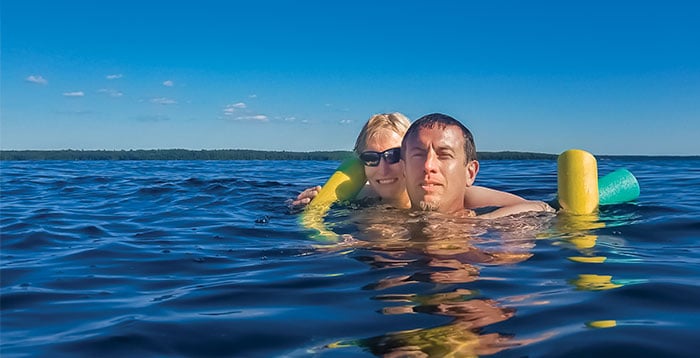
3 Outdoor Activities to Reduce Your Screen Time and Recharge Your Spirit
In a world that’s never been more easily connected, the average American spends about 11 hours per day on a device. According to the Nielsen Total Audience Report, whether we’re scrolling through social media, watching TV or video, swiping through mobile apps or perusing digital media, the majority of the population’s pastimes revolve around staring at a screen; which can be a little bit… disconcerting.

Photo courtesy of Liberty Rogue Outdoors
This unprecedented engagement with technology is also causing an influx of digitally-induced afflictions. “Facebook Depression,” for example, is an actual disorder that correlates social media usage to depression and loneliness.
“Cell Phone Addiction” is also considered one of the greatest addictions of the 21st century, causing all kinds of physical and psychological issues, including rigidity and muscle pain, ocular afflictions, fatigue, insomnia and a loss of interest in social and recreational endeavors. And according to the Journal of American Medical Association, the risk of developing Attention Deficit Hyperactivity Disorder (ADHD) symptoms more than doubles with high screen use.
With all this time spent adapting the body to meet our digital demands, the physical effects of stress take their toll. The strained position of the head and neck with device use is known as “Tech Neck.” It causes unnecessary stress on the spine and reinforces poor posture patterns—bringing some serious long-term consequences such as disc degeneration, arthritis and chronic pain.
The good news is, spending time outside is one of the best ways to undo all that digital damage. Here are three outdoor activities that reverse the negative effects of screen time and recharge your spirit:

Photo courtesy of Portland Paddle
1. Paddling and Stand Up Paddle Boarding
Paddling puts your muscles in the perfect position to open up the front line, stretch and strengthen the shoulders and stimulate the trapezius muscles to combat all that hunching over. Activities like kayaking and canoeing build overall endurance and can carry us to some of the most scenic destinations Maine has to offer. Some studies show that our connection to nature increases attentional capacity and positive emotions, decreases stress and even enhances our ability to solve life problems.
Stand Up Paddle Boarding (SUP) is a fun alternative to traditional paddling and provides a full-body workout at the same time. On top of engaging the entire upper body, SUP flexes deep core muscles to keep you upright and cruising across your favorite body of water.
2. Hiking the Ergo Way
The world’s most tried, true and time-honored pastime — hiking, is one of the easiest ways to get away from your desk for even just an hour. Just you, your backpack and the profound sounds of nature. The benefits of hiking are almost too many to list: cardiovascular engagement, decreased blood pressure and stress, overall enhancement in physical and mental wellbeing, and most importantly: restored attention. There’s no WiFi in the woods, so there’s no temptation to break your focus.

Photo: Mike Leonard
To maintain healthy alignment, however, choose your backpack wisely. Ergonomic backpacks are padded for your spine, designed to reduce the strain on your neck, easy to adjust, and facilitate overall ease in your hiking experience. Some important features to look for include wide straps, a waist strap, multiple compartments to evenly distribute weight and proper contact of the body with the pack. The more adjustable the pack, the more comfortable and enjoyable your hike will be.
3. Swimming
Swimming is a low-impact aerobic activity that reduces joint stress, increases personal strength and promotes overall spinal decompression. It’s also a chance to connect with nature in a truly immersive way.
Whether it’s charging through the ocean waves, drifting down a flowing river or floating along a calm lake or pond, swimming offers you the chance to build up a healthier spine and reverse the dreaded screen time.
However you choose to engage with the outdoors, remember to put the phone away. A simple reset is often the best remedy for tech burnout. Get outside, get moving and experience all the offscreen Maine has to offer!
— Text: LeeMarie Kennedy. LeeMarie is a copywriter and content marketing specialist in Boston, Massachusetts. When she’s not meticulously wordsmithing, she can be found teaching as a certified yoga instructor, exploring her own yoga practice, traveling the world, laughing, drinking coffee or eating something delicious.

Five Medicinal Maine-Grown Products
Maine is lucky to host a unique and abundant assortment of delicious, nutritious plants and herbs. From season to season, it brings forth a variety of native vegetation that, in many cases, only requires a step outside into your own backyard or a trip to your local store to procure. Here is a list of five medicinal Maine-grown plants, herbs and vegetables that are easy to get or grow, and offer proven benefits to your health and wellbeing.
 1. Wild Blueberries
Maine’s official state fruit had to make the list! Research shows that wild blueberries (also called low-bush blueberries) are jam-packed (see what we did there?) with antioxidants and phytochemicals, particularly one called anthocyanin, which helps reduce the risk of cardiovascular disease, death, and Type 2 diabetes. They also help maintain a healthy weight and reduce inflammation in the body. It’s widely agreed that the regular consumption of these “super fruits” is great for your health.
Where can you find wild blueberries? You guessed it. In the wild. These hardy, tiny blueberries thrive in challenging seasons and in glacier-churned soil. Most of Maine’s wild-blueberry harvesting is done by commercial operations, such as Wyman’s in Milbridge, but many farms, such as Alexander’s Wild Maine Blueberries in Greenfield or Beddington Ridge Farm in Beddington let you rake in your own during the peak season of July through September.
 2. Potatoes
The potato is northern Maine’s primary agricultural product. According to Maine Potatoes, one medium-sized potato has only 100 calories and is made up of about 80 percent water. It also contains 45 percent of your daily recommended vitamin C and 21 percent of daily potassium. Potatoes are packed with antioxidants linked to reducing the risk of cancer, as well as vitamin B6 and fiber, which are found mainly in the potato’s skin.
If you’re looking for farm fresh potatoes, the Maine Potato Board has a long list of growers across Maine, including Davis Egg Farm in Newport, Green Thumb Farms in Fryeburg and Northeast Potato Distributors in Littleton. Trying to grow your own? You can pick up seeds and gardening tips at Johnny’s Selected Seeds in Winslow, ME.
 3. Sassafras
Sassafras is a native woodland tree that grows year-round and makes a fragrant and potent addition to your home garden. It smells a bit like root beer, cinnamon and citrus, so steep it in a killer cup of tea. Its reported health benefits include improved urinary tract health, circulation, digestion and immune health. It even reduces the symptoms of arthritis and gout. Where can you find this powerful and pungent herb? Sassafrass is indigenous primarily to southern Maine, but you can grow your own from freshly collected seeds. Learn more about how from the Wild Seed Project in Portland.
 4. Shagbark hickory
Shagbark hickory, a member of the walnut family, is found across southern Maine. It’s a shaggy looking tree with a dark charcoal bark that lives for upwards of 200-to-300 years, producing nuts with health benefits that include increased circulation, heart protection, a boost in metabolism, lowered cholesterol, improved digestion, and even bone growth from its dense supply of magnesium.
While locating shagbark hickory in the wild might require a trip to southern Maine, you can find their ripe nuts ready to pick in September, at a local farmer’s market, (a list of which can be found at mainefarmersmarkets.org) or by planting your own and watching a new tree grow. Learn more about how from the Wild Seed Project.
 5. Locally Grown Hemp and CBD Oil
Maine is home to more than 2,000 acres of farmed hemp and 170 hemp growers. Cannabidiol, also known as CBD oil, is a chemical that’s extracted from the cannabis plant and used in a wide variety of ways, both topically (in creams) and through ingestion (edibles). CBD products sold in Maine must be made with locally grown hemp. Some of the benefits of CBD oil include pain relief, anxiety and depression reduction, nausea alleviation, acne treatment, a boost in heart health and even diabetes prevention.
Wondering where to get your hands on Maine-grown hemp or CBD oil? According to Best CBD oils in Maine.org., some of the top places to buy CBD oil in Maine include Not Another Glass Shop in Brunswick, Remedy Compassion Center in Auburn, Empire Vape Shop in Waterville and East Coast CBD in Unity.
We’re Wild About Maine’s Bounty
Whether it’s those tiny little blueberries packed with health-boosting nutrients or the shagbark hickory trees that stand to outlive us all, you don’t have to look very far to find foods and remedies to help you stay healthy and happy. With a little bit of research and the right grower, Maine makes it easy for you to experience nature’s bounty at its finest.
— Text: LeeMarie Kennedy. LeeMarie is a multi-niche copywriter, editor and content marketing creator in Boston, Massachusetts. When she’s not meticulously wordsmithing or brainstorming a trending topic, she can be found teaching yoga, wandering the world, drinking fair trade coffee or eating too much cheese.
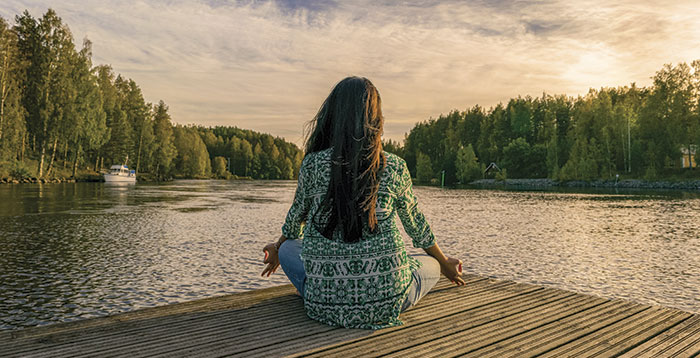
Meditation and Healthy Weight
As summer approaches most people want to improve themselves, starting with achieving and maintaining a healthy weight. In my ‘Weight Loss Journey’ workshop, the two ‘A’s that form the foundation of the program are: awareness and accountability.
 AWARENESS
Let’s begin with awareness and the practice that is specifically designed to produce it. Meditation is the key that brings you into a “here-and-now” state of awareness, expressed in terms such as “mindfulness,” “being in the moment,” “in the flow” or “in the zone,” and so on. If you engage in this practice, producing a state of meditative awareness, you are ready to achieve your healthy weight and maintain it in a new way.
To bring your “here and now” awareness out of your meditative practice and into your daily routine, start with your food intake. Begin by staying aware of your intake for one day. Use an index card, sheet of paper, tablet, journal, or a section of your planner or calendar to record everything you eat. Notice that I did not say to restrict yourself or deny yourself anything that you would normally eat. You can eat anything you want, as long as you write it down. The skill you are developing here is the accurate recording of your food intake.
ACCOUNTABILITY
The second ‘A’ is accountability, and refers to counting calories. When people tell me they have a hard time losing weight, but don’t want to count calories, it’s understandable. But, the fact is, that whether or not you are counting, that number of calories translates to fat and weight gain, maintenance or loss. The ultimate goal here is to determine the number of calorie intake that is ideal for your age, weight and activity level, then go through an entire day without surpassing that number.
 After your “Day One,” research an online calorie tracker or by the nutrition label what you have consumed. Then total the calories for your one-day count. That’s it. You’re on your way! Now do it again the next day, and the next. After seven days, you’ll have a sense of the kinds of food you usually eat, and the amount and most importantly, the calories that come with each food choice. With your knowledge of your own personal eating patterns and which foods are the better choices, you will start making choices with fewer calories, yet are still satisfying. The more items you record, the easier the process becomes. This is the most effective method, since it works from your own personal food preferences.
Not every day will feel like a success. If you do succumb to an impulse, consider why. It might be a way to escape your present moment or to escape how you feel in the moment. Realize that this is the power that the item has over you. Think of an alternative to the food/drink that you consume. Your goal is to feel satisfied, to feel good, to feel safe or secure, to feel engaged, without that particular item. Have your alternatives ready. For example, sometimes your stomach simply wants that full feeling, and you can drink a glass of cold water with a lemon wedge to fulfill that craving, rather than eating that sandwich at night. Or you can choose a filling low-calorie snack instead of one that you now know is high-calorie. Choose whatever alternatives work for you. Test your ability to stay aware (in the moment, etc.) when the urges occur, and your power to choose your alternative items will increase. When you succeed and an impulse finally passes, you will feel that you have developed a new kind of power in your life. And if you do succumb to a certain food, admit the power that the item had over you. Acknowledge how great the challenge actually is; and start again!
— Text: Anthony Rubbo

11th Annual Champion the Cure Challenge
Champion the Cure Challenge is happening this year, but it’s virtual!
YOU Make The Challenge.
Take The Challenge in your own creative way and continue to help cancer patients and families. Learn more and register for this year’s Challenge at ctcchallenge.org, and don’t forget to follow us on Facebook.
Here’s how you can participate – Find your own way to take The Challenge! Hike, bike, paddle, or a ride your favorite four-legged friend around the stable.
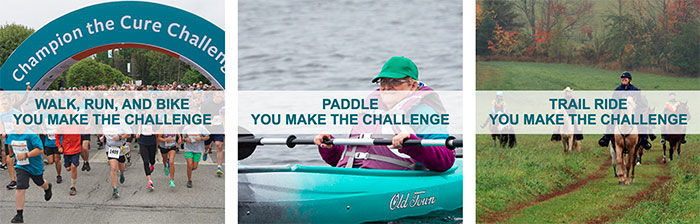
Take photos or a brief video of your journey between now and August 1 and share it on Facebook with the hashtag #YouMakeTheChallenge (Email us at ctcchallenge@northernlight.org if you don’t use Facebook). We’ll share some of our favorites. (See additional guidelines and suggestions).
Join us for a special virtual celebration on Saturday, August 15!
We’ll share stories and videos from the virtual Challenge, see how The Challenge is helping patients and families, and kick off the 2021 Champion the Cure Challenge.
Patients and families affected by cancer need our support now more than ever, but that support can come in many ways. For 2020, participants can choose to pay the regular registration fee, or register at no cost. What’s most important is that we’re coming together to make a difference.
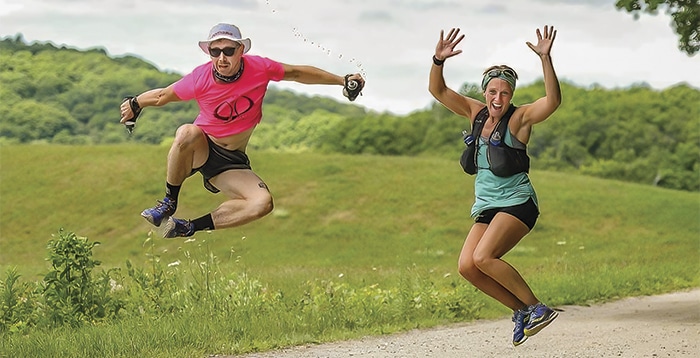
Your Races are all Canceled, Now What?
It all started with Boston. On March 13, the B.A.A. announced that the Boston Marathon would be postponed from its original date of April 16 to the fall. Just two weeks later, Western States Endurance Run canceled the 2020 event originally slated for late June. With those iconic races making adjustments, it was expected that other races would follow suit, and they did.
That rockin’ 2020 race schedule you planned out to keep you motivated during the winter is now completely shattered. Now what?
1. Run the spirit of the event. Just because there won’t be hundreds of people around, doesn’t mean you didn’t train hard and can’t still cross your own finish line. Map out that 13.1 mile loop around your part of town and have those two free beers waiting for you on your front porch when you finish. (That is why people sign up for those half marathons, right? Free beer?)
Some events are still on, just virtual this year. Mari Balow, from Grind Run Company reports “We put up a virtual challenge and had more runners complete a 55k in April than we could have imagined. They ran alone, for some, a distance much farther than they had ever attempted, for no medal or official stats. Astounding grit and determination!”
2. Prepare for next year. Many races that were canceled are offering refunds or free deferrals to their 2021 events. This definitely softens the blow of the canceled event, knowing you’ll be at the starting line next year and allowing you to rebuild your race schedule.
“The Grind Run Company is likely to cancel our two premier 2020 events, but we are offering deferments to registered runners. Our goal is to come back even stronger in 2021.” says Balow.
3.Relax. Yes, you put in a ton of work leading up to your event. Yes, it is frustrating to see your “A” race get delayed a full year. However, it is something we are all going through together. It is more important than ever to take a deep breath and relax. This is all new and we are all figuring it out together. Take this time to run for yourself.
At first, I was pretty bummed out that both my 100-mile races were postponed until next year. I had spent hours over the winter in harsh conditions romping around trails by myself to prepare for these events. When I received the news that these events were not going to be held this year, it felt like all my training was for naught. I eventually pulled myself out of that rut and refocused that energy and effort into a few running projects involving the Eastern Trail. The purpose of these projects is to give me the motivation and opportunity to push myself on those now canceled race dates. So while I may not be seeing any of you at a starting line anytime soon, give me a wave on the trail.
— Text & Photo: Todd Reutlinger is a local ultra and trail runner. When he isn’t running, you can find him shipping shoes and fitting feet at Fleet Feet Maine Running.

The Seasonal Runner: Leaping into Spring & Summer
The sweetness of that very first spring-like run of the season is intoxicating. Runners shed their winter layers and emerge from their treadmill lairs to drink in the warm, earthy air. The roads and trails are clear, days grow longer, and plant life gives birth to new leaves and buds. We, too, are innately connected to this pattern of growth and renewal. Suddenly, a motivation that was once dormant, breaks through. There is a palpable energy in the air, and that is especially apparent to anyone with a running mindset.
The turn of the warmer weather is often met with a zeal and eagerness to train harder, achieve that PR, or even to lace up a pair of running shoes for the very first time. Ideally, we are taking cues from nature, and honoring these natural cycles; not overdoing it to risk injury and burnout, and training in ways that improve our performance, while allowing for sustainability and continued enjoyment in the sport of running. Here are a few points to keep in mind as we enter this exciting time of year.
GOAL SETTING
Think about what you want to achieve. Do you want to commit to running more days per week? Do you want to go longer or faster, or snag a race PR? Goals should have personal meaning, rather than meeting someone else’s expectations. By being specific and realistic, you will be in a better position to commit to the work required to meet whatever goal you set.
YOGA
Yoga poses work the body in ways that can bring tremendous physical, energetic and mental benefits. Let your yoga practice work with your training, and not in opposition. On high mileage or active days, give in to a restful practice; and on lighter days, you can allow your yoga to focus more on strength and movement. The following short sequences highlight three poses for each purpose. Add them to your routine to create more balance and see how you feel.
YANG / DYNAMIC
CHAIR POSE
With the feet together or hip width, draw the hips back and down like you’re reaching for a chair. Let the weight be heavy in the heels and light on the toes. Feel the outer hips compacting as the torso lifts off the thighs and the chest is upright. Keep the hands at the hips or raise the arms as shown.
HIGH LUNGE
From Chair Pose, pour the weight on the right leg as you lift the left foot and draw it back behind you, so you land in a lunge. Through that transition, keep the outer right hip exactly as you had it in Chair Pose. In the High Lunge, you may experiment with a bent or straight back leg as you keep a tall spine and even explore a subtle backbend.
WARRIOR 3
From High Lunge, shift the upper body forward and bear the weight in the front leg, again keeping the right hip pinned in and drawing back, which engages the glute and hamstring. As you lean forward, keeping the chest searching forward, and spine long, lift the back leg. Work to keep the hips level – right and left hip bones facing the floor evenly. Keep the back leg lifted by engaging the quadricep and drawing the inner line of the leg toward the ceiling. Step to Chair Pose, and then to a standing position.
Flow through these three poses, alternating from right to left. Experiment with holding for 3-5 breaths in each pose, and then moving dynamically, holding for 1 breath per pose, and performing 5-10 times on each side.
YIN / PASSIVE
SPHINX
Place the elbows under the shoulders, keeping the legs relaxed. Head may be kept in a neutral position, fall forward, or rest on a block.
BUTTERFLY
From a seated position, draw the soles of the feet together, allowing the knees to go wide. Let the feet be further away from the hips, and incline the body forward.
CAT TAIL
Lie on your right side, supporting your head in your hand. Draw your left leg up, like you’re hanging out reading a magazine. Reach behind you with your left hand and catch ahold of your right foot, targeting the quadricep of the back leg. Stay on your side, or roll back (as shown in the photo), to invite a twist to the spine.
Hold each pose with the muscles fully relaxed, allowing the body to become heavy. Go only to the point where you feel a mild amount of sensation – nothing sharp or painful. Set a timer and hold each posture for 3-5 minutes.
[/ezcol_2third] [ezcol_1third_end] [/ezcol_1third_end]
—Photos: Yang: Terry Cockburn, Yin: Cindy Giovagnoli
Terry Cockburn has been teaching yoga since 2006 and owns Freeport Yoga Company (Freeport, Maine) and Yarmouth Yoga Studio (Yarmouth, Maine). A marathon runner, mother to two boys (and one yellow dog), business owner and outdoor adventure seeker, she balances an active yang lifestyle with time on the meditation cushion and a contemplative yin practice. Terry teaches classes, workshops and retreats and has a passion for working with the athletic population. Check out her upcoming offerings at www.freeportyogaco.com.
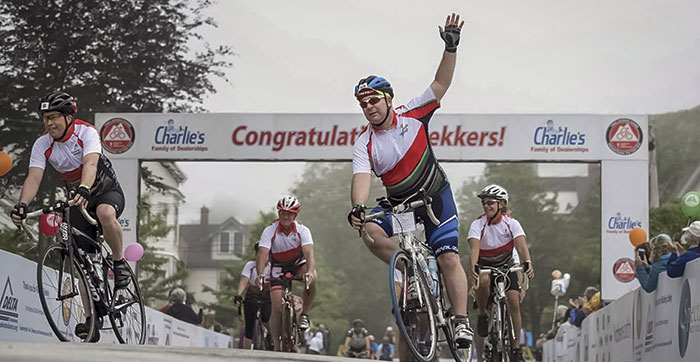
Trek Across Maine Shifts Gears in 2020
For the first time in history, The Trek will be a 100% virtual event!
The announcement was made recently by the American Lung Association. Out of an abundance of caution and to prevent the spread of COVID-19, the Association has adjusted plans for the 2020 Trek Across Maine. There will be no physical event on June 19 – 21, but instead, Trekkers can participate in a virtual Trek Across Maine from now through June 30th.
While the decision was made to protect the safety of participants, volunteers, and staff, organizers are hoping the new virtual experience will encourage more participation from new and past Trekkers from around the country. There has already been a spike in registrations and many more are anticipated to register since a portion of the funds raised by the Trek Across Maine will support COVID-19 research.
 HERE’S HOW YOU CAN PARTICIPATE IN THE VIRTUAL TREK:
The virtual Trek Across Maine encourages Trekkers to stay active and enjoy time on their bike (practicing safe social distancing) while supporting the work of the American Lung Association. Completing mileage is not a requirement to participate.
Share your photos and videos of your progress on social media using the hashtags #TrekMe and #Cyclingtogether. You can use activity tracking devices (Apple Watch, Fitbit, Garmin devices, etc.) or join our Trek Across Maine Strava Club to see where you rank on the leaderboard each week with other participants as you ride!
Register at trekacrossmaine.org before June 30, as a virtual participant for just $15.
Participants can ask family or friends to donate to the fundraiser to raise $250 (the fundraising minimum has been adjusted this year to be sensitive to these challenging times). By meeting the fundraising minimum, the participant will receive a commemorative 2020 Trek t-shirt, accomplishment medal, and rider bib.
For more detailed information on the virtual event, including additional incentive levels (including the prestigious Winner’s Circle jersey), ways to stay connected and how to communicate with your donors, visit trekacrossmaine.org
EVERY MILE COUNTS
Since 1985, the Trek has raised more than $29 million for the American Lung Association. Funds from the event will go to support programs like research to prevent the spread of COVID-19 and help save lives by improving lung health and preventing lung disease.
Recently, American Lung Association researcher, Dr. John Schoggins, Ph.D., was credited with identifying a naturally occurring protein that has been shown to inhibit coronavirus infection. It was announced in April that the American Lung Association is launching a $25M initiative to end COVID-19 and defend against future respiratory virus pandemics.
You can also make a general donation to support the event or someone you know who is participating by visiting TrekAcrossMaine.org.


What’s New in Running Gear
RaceME sat down with John Rogers, owner of Fleet Feet Sports Maine Running and Erin Flatley, Marketing and Social Media Manager, to learn about trends we can expect to see in running gear this year.
Starting with shoe trends, companies are leaning toward lighter weight and more cushioning in their designs. Here are a few of the latest shoes that showcase this new technology:
The Hyperion Elite (pictured above) is the fastest racing shoe from Brooks that’s built around a unique carbon-fiber plate, and like the other carbon-fiber-plated shoes, this plate provides a more propulsive feel and quicker transition. Brooks engineered their plate with a specialized spine that runs down the middle to help resist bending and improve support.
Packed around the plate, Brooks used an ultra-lightweight foam called DNA Zero. The feathery new DNA Zero foam is lighter and softer than Brooks’ standard BioMoGo DNA, which reduces the strain on your muscles and, in turn, holds off fatigue as long as possible. Retail $250
 HOKA’s Carbon X shoe is an everyday trainer disguised as a racing flat. Built with a carbon-fiber plate smooshed between layers of foam, the Carbon X delivers an ultra-smooth and fast-feeling ride. Retail $180
If you’re looking for a versatile running shoe to take you from training to race day, the HOKA Carbon X is a good choice. The Profly X foam is HOKA’s lightest and most resilient yet, and the wide base makes it stable for many miles.
“Personalized shoes and orthotics are becoming more available,” Rogers said. “We will see personalized orthotics turned around for customers in about a week. As shoe innovations continue to be aided by the latest technology in 3D imaging and scanning tools, we will see more ‘real-time’ details for measuring gait characteristics from ‘heel strike’ to ‘toe off.’ ”
 Nike’s latest marathon running shoe, the Air Zoom Alphafly NEXT%, has a carbon-fiber plate, and gets a boost from Air as well. Nestled into the bulbous ZoomX foam midsole is a pair of Zoom Air Pods. Working with extremely responsive foam, Nike’s Air Pods add another level of cushioning and energy return to help runners conserve every precious ounce of effort. Retail TBA
A single, full-length carbon-fiber plate provides stability on top of a big stack of foam, while also increasing the shoe’s stiffness, creating a smooth transition and adding a sensation of propulsion.
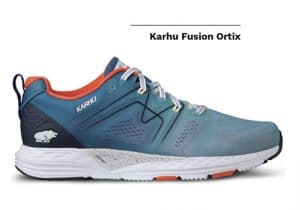 Fleet Feet and Karhu Collaboration
The new Karhu Fusion Ortix is better than ever. Shaped by scans and built to run, the Karhu Fusion produces a comfortable, reliable ride. Built with the help of more than 100,000 3D foot scans taken through Fleet Feet’s Fit Id outfitting process, the scans help ensure the best possible fit and to be able to run in comfort.
Redesigned with a sublimated engineered upper, the Fusion provides a seamless feel and secure fit without losing the stable landing and forward momentum of the previous model.
Underneath, the Fusion uses Karhu’s proprietary Aero Foam cushioning. The foam offers a lighter, cushier feeling than typical EVA, and it’s more resistant to temperature changes.
Embedded into the midsole is Karhu’s signature fulcrum technology. The Fusion has a three-fourths-length fulcrum that increases support in the middle and promotes a forward rolling effect.
Retail $140
RUNNING ACCESSORIES
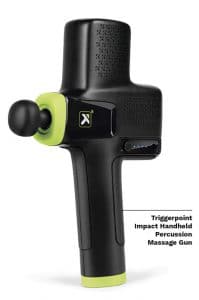 According to Flatley, the TriggerPoint Impact Handheld Percussion Massage Gun is becoming more popular in the area of runner recovery. “Almost everyone says they need one after trying it,” she said.
This four-speed muscle massage gun delivers targeted pressure to help increase blood flow, hydrate muscle tissue, and improve range of motion pre- and post-workout. It features an angled handle with a top-weighted design that provides comfort and ease of use, and allows for better control and dexterity. Other features include:
- A universal massage head optimized for use on multiple muscle groups
- A quiet, brushless four-speed motor that runs efficiently with a rechargeable battery that supplies more than two hours of continuous massage.
- A lightweight and travel-friendly size measuring 10.3 x 7. 5 x 2 inches and a weight of 2.4 pounds for $199.00
RUNNERS REHAB
As for the most common ailment they see in the store? That would be Plantar Fasciitis, which is an inflammation of a thick band of tissue that connects the heel bone to the toes. There are several ways to help relieve this common foot pain.
Orthotics, either custom-made or manufactured. Fleet Feet Maine Running stores carry SUPERfeet insoles that offer arch support for various arches. This support, plus the fresh cushion in shoes definitely helps ease the pain.
Wheel rollers for the bottom of foot and various self massagers and foam rollers to massage out calves, shins and lower leg
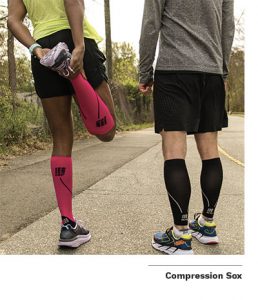
Specialty compression socks that have more compression in the arch that are found to help in many cases.
Speaking of compression, compression sleeves for legs are becoming popular amongst runners to alleviate calf and lower leg pain by bringing more blood flow to the area. “Some people really like the compression sleeve and they are becoming more recommended for active exercise across many sports,” said Flatley. There are also full compression socks to prevent blood pooling while you are not exercising. A full compression sock can worn most anytime. Marathon runners are at an increased risk of a blood clot when traveling long distances.
TRENDS IN RUNNER SAFETY
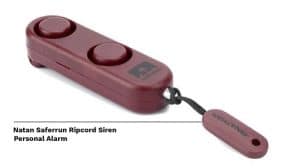 There are several products out now designed just for the runner market. The Nathan SaferRun Ripcord Siren Personal Alarm was named Time Magazine’s Best Invention in 2019. This tiny device blasts sound at 120 dB and can be heard up to 600 feet away. The alarm system acts as a deterrent and can also alert others in case of an incident. Additionally, the Ripcord Siren can be used multiple times. Cost: $20
Pair this mighty alarm with the latest in reflective gear, light up vest and bright clothing along with other deterrents (like pepper spray) you can run confidently and with peace of mind.
PRO TIPS TO EXTEND THE LIFE OF YOUR SHOES
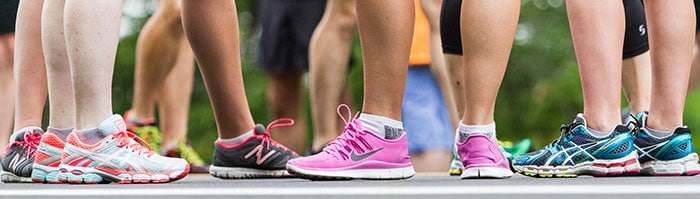
Photo by Kevin Morris
1. Only wear the running shoes when running.
“Mileage is mileage, and even just standing, due to the compression, will take its toll,” said Joey Michaud, Fleet Feet Maine Running stores’ Retail Experience Manager, who then provided a great analogy “It’s similar to how carbonated beverages lose fizz over time and go flat. It’s the same with the composites that make up the encapsulated air inside the shoe material. With every step, you are compressing that material down further and further.”
2. Alternate with another shoe.
Around halfway through the life of your main running shoe, begin alternating, and and slowly incorporate it in. This allows your main shoes longer time to recover between runs, which allow them to maintain their structural integrity for longer.
3. Do not wash your shoes in a washing machine.
Instead, use a sponge and a toothbrush with soap and water. If you do get your shoes soaking wet on a run, take the laces and inserts out and let all parts dry completely.

4 Ways to Infuse Mindful Moments Into Your At-Home Workday
In the age of instant access to technological tools and communication channels, some of today’s employers are finding it even easier to heap on the expectations. Working longer hours, being online at odd times and a list of to-dos can make it tough to slow down.
The good news? You can still accomplish plenty of work without letting stress get the best of you with small, simple moments of mindfulness. Mindfulness is the practice of focusing on the present moment while calmly assessing your thoughts, feelings and bodily sensations.
According to Nancy Hathaway, Maine native, founder of the Center for Studying Mindfulness, “The key is to experience feelings as body sensations; rather than going to the gerbil cage of over-thinking. When you are at work, take a mindful walking break to the water cooler or bathroom, or get yourself outside.”
Your job is likely a crucial part of your life. It might be your lifelong passion, your primary source of income, a way to help your community, and the place where you spend the most time. To help you use that time wisely, here’s a list of four ways to break up your workday with mindful moments:
1. Create a Mindful Eating Experience
According to Harvard Health, mindful eating “includes noticing the colors, smells, flavors, and textures of your food; chewing slowly; getting rid of distractions like TV or reading; and learning to cope with guilt and anxiety about food.” Basically, it’s taking a real break and allowing you to focus on the act of eating without distraction.
Why is this helpful in combating stress and cultivating ease? Research shows that focusing on your food, feeling its weight, examining its surface, smelling it, noticing how it makes you feel and closing your eyes to savor it fully can help you practice non-judgment, patience, non-striving, acceptance and trust. All of these are essential for kickstarting feel-good hormones such as dopamine and reducing stress hormones such as cortisol. So next time you need a time-out, grab a piece of fruit and take those measured steps to ensure eating it is a full mind- body experience.
 2. Practice Mindful Movement
Mindful movement is a way to take a break, listen to your body and engage in physical activity that feels fluid, unforced and natural. Focus on noticing your body in movement and controlling the pace of breath. Some of the most common types of mindful movement include yoga, pilates and tai chi, but the simple act of going for a walk or stretching in your office can give you the same stress-relieving benefits.
One easy tactic: find a private space to practice an inversion, also known as “Legs Up the Wall Pose” in yoga. By getting your feet above your heart, you can boost your circulation and counter the results of all the sitting that occurs in day-to-day office life.
3. Sprinkle in Some Meditation
Just 10 to 20 minutes of meditation per day has been proven to increase focus, positivity and productivity, decrease stress, streamline communication skills and even build stronger relationships. These are all essential components of a happy, productive work life.
Meditation doesn’t have to be complex or intimidating. It can be the simple act of taking a comfortable seat, closing your eyes, and taking deep, measured breaths. You can even adopt a mantra, or phrase you repeat in your mind, such as: “I breathe in. I breathe out.” Use technological tools to your advantage by downloading one of the many meditation apps available online.
4. Get Outside
Spending 15-to-30 minutes outdoors is proven to improve relaxation and enthusiasm as well as eliminate nervousness. Research from Harvard Medical School suggests mood disorders can be lifted by spending more time outdoors. The visual aspects of taking in nature’s beauty, even if it’s a budding tree right outside your office, according to the same research, help distract the mind from negative thinking.
Since Maine has the luxury of being one of the most majestic places to experience nature at its finest, take that break and take advantage! You might enjoy a quick bike ride, see the scenic coast, strike an outdoor yoga pose or even take a half- or full-day rock climbing tour.
There’s no reason for your workday to ever be a drag. By engaging in mindful activities that work for you, whether it’s being outside, in your office, at a local cafe or on a journey inward, carving out the time to put yourself first and live in the now can help every day feel like the weekend. .
— Text: LeeMarie Kennedy. LeeMarie is a multi-niche copywriter, editor and content marketing creator in Boston, Massachusetts. When she’s not meticulously wordsmithing or brainstorming a trending topic, she can be found teaching yoga, wandering the world, drinking fair trade coffee or eating too much cheese.

Staying Calm, Strong and Healthy During Social Distancing
With the levels of stress so high right now, self care is very important! There are many things you can do from home to get exercise and relieve stress. Try biking, walking/running outside, hiking in the woods, eating nutritious food and hydrating well. Take care of your mind and stress levels by getting good sleep, meditation, yoga, journaling, and deep breathing exercises. Catch up with your family and friends on the phone or video chat.

Photo: John Hafford
Good sleep is critical.
Recent studies show that sleep may be your best ally for staying healthy, so here are some basic tips for getting better sleep. Light to moderate exercise during the day or morning helps most people sleep better at night. Unwind 1 to 2 hours before bed, which means no digital devices or screens. Take a shower or bath to relax and keep your room cool and dark. Before bed, think thoughts of gratitude — what you are thankful for — and then shut out the world. Focus on what you notice going on in your body first, then once you scan your body systems, focus on your breath. Notice its sensations getting lighter, and then drift off to sleep.
Boost your levels of Vitamin D.
Next, we recommend, if you are able to go outside, that you get 20 or more minutes of direct sunlight at a time. Vitamin D that is produced from sunlight being absorbed by your exposed skin is a huge immune and mood booster. If you can’t get outside, find a sunlit part of a room and soak in the warmth of the sun on your exposed skin. Although sunlight through windows is not as powerful, it still has a healing and relaxing effect, and you can safely stay in it for longer periods.
Give your mind a rest.
Break away from the news and social media. While it is very important to stay informed on a daily basis with the rapid changes going on, it is also important not to be glued to it. There is a limit to what your mind can take and you need to be mindful of the toll that sedentary preoccupation with constant watching of devices has on your body and mood. Check updates in the morning and evening, and take notice of any special announcements for your state or areas when they are released.
For those of you home with the kids for the next two weeks, here is a link for 15 Fun And Easy Family Activities That You Can Do At Home:
https://www.lifehack.org/articles/lifestyle/15-fun-and-easy-family-activities-that-you-can-home.html
We look forward to the day when we can start to transition from “Social Distancing” and we can release our event recommendations with low or no risk of virus transmission. Stay safe and healthy everyone!
— The Crew at Activity Maine

Take a Midcoast Hike

Photo: Elizabeth Berry MacKenney
Maine is known for great hiking, and many enthusiasts flock to Katahdin and the Camden Hills. But there are some beautiful, lesser-known trails in the midcoast region. Lincoln county, for example, has some beautiful, easy trails that are open year-round — for free. When visiting Boothbay, Damariscotta, or Pemaquid, be sure to check out some of the trails there for gorgeous views and close encounters with flora and fauna.
Boothbay Region Land Trust
From easy to challenging, the Boothbay Region Land Trust has over 30 miles of trails all over the Boothbay Peninsula, and they even maintain trails on Damariscove and Indiantown Islands. Guided walks are often available year-round. A schedule of upcoming events can be found on the BRLT website, which also has maps and a trail guide. Cost: Free. www.bbrlt.org
Damariscotta River Association
Up the road a bit from Boothbay Harbor is Damariscotta. Winding down the peninsula from Damariscotta to South Bristol is the beautiful Damariscotta River. All along the river, you can find trails of various levels of difficulty, maintained by the Damariscotta River Association. If you have small children interested in taking a hike, and easy one to try is located at the River Association’s farm on the Belvedere Road in Damariscotta. The Dodge Point preserve and hiking area located on the River Road in Newcastle is very popular with both locals and visitors to the area. The website for the Damariscotta River Association contains a map of all their preserves and hiking areas. Cost: Free. www.damariscottariver.org

Photo: Activity Maine
Pemaquid Water Association
If you’re taking a drive to Pemaquid to see the beautiful Pemaquid Point Lighthouse, consider taking a quick hike on one of the many trails maintained by the Pemaquid Water Association. Eight preserves and five hiking trails along the Pemaquid River, from Nobleboro to Bristol, are maintained by the PWA. Detailed maps and descriptions of each hiking trail are avilable on the PWA website. Cost: Free.
Check out one, or all of the trails at these great locations. Each offers a unique view of the astounding natural beauty around Lincoln County. If you would like to bring a dog to any of the areas listed, check the websites first. Most allow canine companions, but it is recommended to keep your dog on a leash. And please clean up after your pet! www.pemaquidwatershed.org
— Text: Kate Kastelein
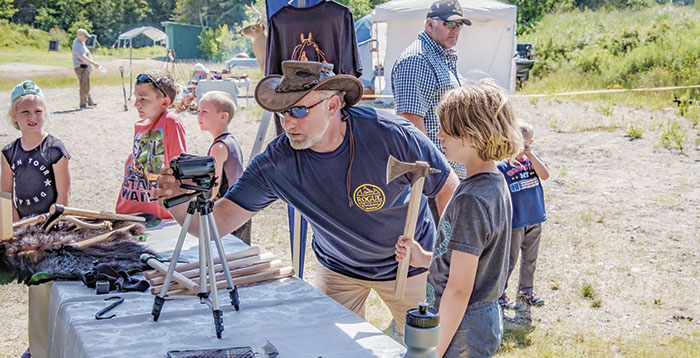
The Art & History of the Tomahawk
What is a tomahawk? Is it a functional tool, a weapon; or a historical art piece? If you ask me it’s all of the above.
 The tomahawk, a single-handed axe that traditionally resembles a hatchet, is an iconic weapon that was first developed by the Alogonquin Native Americans. The word tomahawk was derived from the Alogonquin word “Tomahak” or “Tomahakan,” meaning “used for cutting.”
The Native Americans made tomahawks with stone heads attached to wooden handles, secured with rawhide and sinew. It was a general-purpose tool used for chopping, cutting, and even used as a weapon.
Four hundred years ago, the Europeans introduced metal blades as an alternative to the tomahawk’s primitive stone blade or deer antler. Settlers, American soldiers and Native American tribes quickly integrated the use of metal into the design of the tomahawk from that point forward. During the Revolutionary War in the late 18th century, the Continental Congress required all military men to carry either a tomahawk or a cutting sword. Tomahawks have even been used during World War II, The Korean War, and in Vietnam. You can even find it being used by the armed forces of today as well.

Photo: Michael Eric Berube
The tomahawk grew in popularity among the Native Indians, frontiersmen, trappers and European settlers. The meaning of the tomahawk grew beyond its use as a tool or a weapon. It became an integral part of everyday society; signifying status among peers, including friends and foes. It was even used and given as a diplomatic gift.
The tomahawk came to symbolize both war and peace. If a red-painted tomahawk were placed in front of the chief during a war council, the war chief would deliberate and raise it to rouse the warriors to declare war. However, if the tomahawk were buried, that symbolized peace—giving rise to the phrase— “burying the hatchet.”
A peace pipe could also be incorporated into the design of a tomahawk with a hollow handle and a type of bowl forged into the head. Some were very ornate used for ceremonial and tribal meetings or during treaty signings. Any way you chop it, the tomahawk has an important place in history.
Today, the tomahawk continues to be a functional work of art, made with drop forged, differentially heat-treated, alloy steel. The handles can be custom engraved, decorated and sold as art pieces.
HOW TO THROW A TOMAHAWKMove over darts, the art of throwing sharp objects has a new competitor. All across the country, tomahawk and axe-throwing has become a big attraction at local establishments, outdoor venues, fairs, brew pubs and other events. Now I’m not big on throwing axes, but throwing a HAWK; that’s more my style. The tomahawk is the easiest weapon to master. Young and old can learn the art of throwing with some instruction and a little practice.
The target First you will need a target. A 4×6-inch thick cut from a piece of large pine or cedar log that is about 18-24 inches in diameter is commonly used. You can either make a stand to hold it up about five feet off the ground, or hang it from ropes with eye hooks. You can also build a frame and use pine boards for your target. The throw To begin, start at five paces from the target. Hold the tomahawk at the base of the handle. (Do not choke up on the handle.) The tomahawk should be held firmly, but not too hard. Bring the tomahawk straight back over your shoulder, and step forward as you throw it at your target as though you are throwing a baseball. The tomahawk should only rotate once at this distance. You may need to move half a step forward or backward to get the tomahawk to stick to the target. Once you get it to stick consistently, staple a paper plate to your target. Keep practicing until you can get the tomahawk to stick to the paper plate on every throw. Then, move back about nine to ten paces. The tomahawk should rotate twice at this distance as you get better at throwing. Before you know it, you will master the art of tomahawk throwing. Most anyone can do this; it’s loads of fun and sure to please your primitive side! Here at Liberty Rogue Outdoors, the tomahawk has always been a part of our outdoor events, bush craft outings, classes and survival kits. I enjoy teaching others how to throw tomahawks and also compete in throwing competitions. We also produce custom tomahawks with hand-forged heads and custom-engraved hickory handles. Each one is a functional work of art. If you’re interested in a custom tomahawk, please contact Liberty Rogue Outdoors at pridesmen@yahoo.com Last thing: “If you bury the hatchet” or in this case the HAWK, don’t leave the handle sticking out –just in case you or the other party changes his mind! (Just kidding!) |
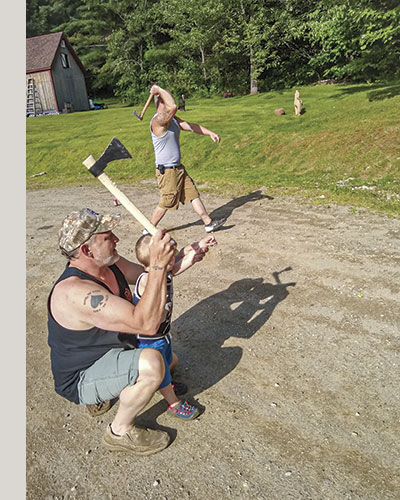
— Alex “TheRogue’stah”Ribar, reminding you to get outside, find yourself a hobby and remember, it’s all about attitude; the right one! Liberty Rogue Outdoors; History Channel’s Alone, Season 4 contestant; Marine and professional survival instructor.

Extreme Indoors
Want to get your kicks year round without the risk of frostbite? Stay social this winter with Portland’s best indoor activities.
If you love the high-octane activity of summer in Maine, don’t lose your momentum over the colder months. These three Portland locales host communities of indoor thrill-seekers who find their adrenaline fix within four walls.
Salt Pump Climbing Gym

A 13,000 sq.ft. Climbing Gym in Scarborough. Photo: Salt Pump Climbing Gym
“Climbing is all about continual education,” said Freddie Wilkinson, co-founder of Salt Pump Climbing Gym in Scarborough. Think you lost the ability to scale anything significant in the third grade? Wilkinson believes the innate ability can be reestablished with a little practice. “Every week we see people surprise themselves by being complete natural climbers,” said Wilkinson. “It’s a fun process to rediscover.” All it takes “is a little flexibility of body and mind and perseverance.”
The 13,000-square-foot climbing gym launched in 2015 with a mission to bring the authentic athletic experience of outdoor climbing to the city, featuring top-rope, lead climbing, and bouldering on walls up to 45 feet high. With 100 new bouldering sequences and new routes set each week, there’s plenty of “continual education” to enjoy, whether you’re tackling green circle or double black diamond climbs. “By nature it’s a sociable sport,” said Wilkinson. “You typically work in pairs, and everyone spends time on the mats discussing route or techniques.” Salt Pump holds daily Intro to Climbing classes, ($40/2 hours) as well as ongoing coaching and outdoor technique training sessions, so no matter what level you’re at, you can keep climbing higher.
Salt Pump Climbing Gym
36 Haigis Pkwy
Scarborough, ME 04074
(207) 219-8145
www.saltpumpclimbing.com
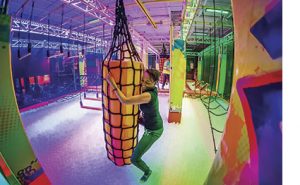
Photo courtesy of Urban Air
Urban Air
If you’re suffering cabin fever this winter, there are worse ways to unleash some energy than at a venue of “wall-to-wall trampolines.” Urban Air in South Portland has just that, plus foam pits, trampoline dodgeball and basketball courts, an obstacle course, and an enormous air mattress known as “The Drop Zone.” The amusement park is family-friendly, featuring a jungle gym and plenty of soft landings for the little ones as well as endless opportunities for older kids, including Friday night middle school socials from 8-11 p.m. Adults don’t have to sit on the sidelines either.
“We welcomed an 83-year-old grandfather onto the trampolines last year,” said Event Coordinator Will Kriger. “He had a great time!”
Trampolining is a serious workout. Challenge friends to a game of bounce basketball and you’re guaranteed to go harder and higher than at any regular gym.
Urban Air
333 Clarks Pond Pkwy
South Portland, ME 04106
(207) 543-4231
www.urbanairtrampolinepark.com

Learning throwing techniques at The Axe Pit
The Axe Pit
The Axe Pit, recently relaunched in South Portland, offers people the chance to sharpen their lumberjack credentials this winter. The expanded 2,000-square-foot venue features six “throwing lanes,” each with two targets, to accommodate more than 60 adventurous patrons. Lanes cost $15/hour for a group or individual session. After your initial safety brief, a seasoned instructor will demonstrate throwing techniques, before unleashing you on the targets.

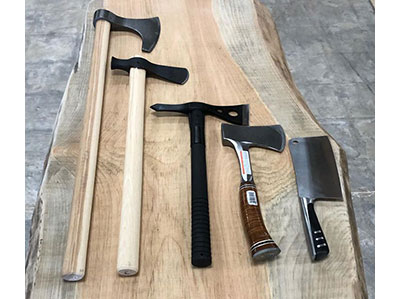
“We offer a selection of tomahawks, hatchets, and even full-sized axes for the intrepid thrower,” said General Manager Connor Winn. “Guests can play cornhole-style, recreate cricket darts, or just throw for fun.” Think of it as high-stakes bowling. Owner Tim Johnson discovered urban axe throwing at an underground venue in Montreal and couldn’t wait to bring it home. “It’s not a big mental leap to imagine how this would fit so well in Maine,” said Winn. The venue’s tagline reads “Social Axe Throwing” and Johnson hopes to offer on-site food and beverages in the near future. If you’re able to relax around flying blades, you’ve found the ideal balance of thrills and chill.
The AxePit
333 Clarks Pond Pkwy
South Portland, ME 04106
(207) 370-4298
www.theaxepit.com
— Text: Saisie Moore. Saisie has worked at Portland Monthly and The Daily Telegraph in London. When she’s not writing, she explores Maine and beyond in a converted camper van with mountain bike in tow.

Four Places to Ski or Shoe at Night
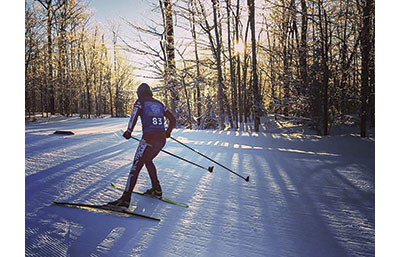
SKIING AT DUSK. Photo courtesy Nordic Heritage Center.
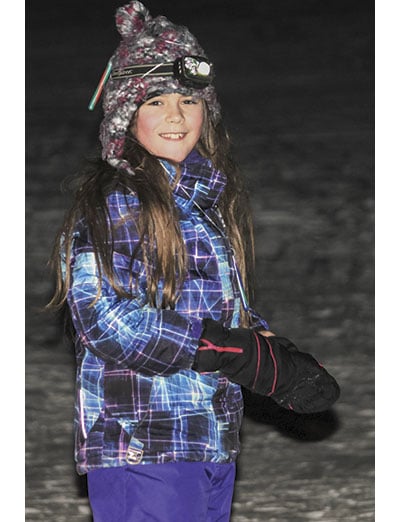
With winters in Aroostook County lasting from November to April, the best way to endure long nights is to get outside for an endorphin rush, fresh air, and stargazing. Fortunately four community-based, Aroostook County venues offer nighttime cross-country skiing and snowshoeing. Three of these family-friendly spots boast day lodges with fireplaces. All offer bathrooms, and are all groomed for classical and skate-style skiing. Up here, getting social in the winter means organized potlucks, snowshoe poker runs, and full-moon events. Perhaps unique to the Aroostook small-town way of life, all are volunteer-managed, and supported by donors, memberships, events, and trail fees. Pack your puffy jacket, headlamp, and toe warmers for an invigorating small-town experience under the stars.

Photo courtesy Nordic Heritage Center
Crisp, dry air seeps around the edges of my buff, the only sound, the click of bindings. Though the sky is peppered with millions of stars, we don’t linger at Red Barn trailhead. The amber glow from a nearby residence warms the landscape as temps hover in the low teens. We warm up by climbing the Volunteer Way trail before descending to the less populated outer settlements in search of even darker skies. Snowshoe hares slip past on the periphery. After an effortless four kilometers of sheltering forests, we make a hard right breaking out into the bright full moonlight of Spike’s Field. We douse our headlamps and race around the loop. Besides the Dippers and Orion, we pick out the constellation Cassiopeia, along with countless sapphires and diamonds in pollution-free skies. After three dizzying laps, we continue on the main trail, reabsorbed by ebony statues of spruce and fir. Perhaps the new moon will allow glimpses of emerald aurora.
Fort Kent Outdoor Center
Fort Kent Outdoor Center, managed by Pineland Farms, was launched 20 years ago as a biathlon venue connecting pre-existing high school competition trails to community trails. Goodwill agreements with several landowners have allowed continued public access to 25 kilometers of groomed ski trails, and 10k of interwoven snowshoe trails. The steep, technical high school ski trails beginning at the community downhill ski area, Lonesome Pine, are best enjoyed during daylight hours, but it’s hard to beat seeing the moonrise at 10th Mountain Lodge, or the pastoral view from Grand Outlook.
Beginners and classic purists will appreciate the gentler Violette Settlement trails accessible three miles west of town on Violette settlement Road or at Red Barn Parking area on Village Road, a portion of which was described in the journal entry above.
Nordic Heritage Sport Club

Photo courtesy Four Seasons Trails
Nordic Heritage Sport Club, also managed by Pineland, was constructed a couple years later as a cross-country ski and biathlon venue. It’s also adjacent to a small, community downhill area, Quoggy Jo. Unlike Fort Kent, all of these trails are on the club’s land. Trails are open from dusk to dawn year-round with 2.5 kilometers of ski trails lit from 4 – 8 p.m. The lodge is accessible via the basement 5 a.m. to 9 p.m. daily. Located at the top of a hardwood covered flatiron-shaped parcel five miles from city lights, this could be your best bet to catch the Aurora Borealis in winter. Family-oriented stargazing events have been added to the club’s repertoire. Two lean-to shelters with outdoor cook stoves invite folks to trek over the hill to the “Fort Fairfield” side bearing thermoses of hot chocolate and fixings for s’mores. For an easy snowshoe hike, park at the entrance on Route 167, where the birch-lined path parallels the access road. Be advised, it’s the only place on the property where you can bring your pooch.
Northern Skiers Club
If it’s flat or beginner terrain you seek, head to Caribou. Northern Skiers Club offers six km ski trails, of which three km trails are lit for night skiing and approximately 3.5 – 4km trails are for snowshoeing. The best part? The trails are free. The sledding hill is also popular with families; just bring your own sled. Both the trails and building were built by the club and donated to Caribou High School. Trail lights are on until 8 p.m. when the building closes.
Four Seasons Trails Association
Four Season’s Trail Association in Madawaska is supported entirely by user and community donations. It offers 14 km of skate and classic skiing, 3km of classic-only tracks, 12 km of snowshoe paths, a kids’ terrain park, and sledding hill. All trails start from the lodge on Spring Street. Just this fall, 1.4 km of the main trail was lit for night skiing. Club President, Colin Jandreau, is enthusiastic about the addition. “Many of the lights are situated where the snowshoe trail crosses the ski trail to provide good visibility in higher traffic areas,” he said. “The button to turn on the lights is located on the timing hut in the stadium right in front of the lodge. Lights will remain on for 45 minutes, and can be reset for another 45 minutes. Most of our users will complete a loop in that amount of time. We recommend that people bring a headlamp anyway.”
There’s no reason to hibernate every night in winter. Grab your constellation app, charge your cell phone battery, and visit Aroostook County this winter – where you’ll revel in the cold, fresh air and our unparalleled night skies. As always it’s a good idea to check for updates on hours of operation, events in progress, and trail conditions.
— Text: Sherry Dubis. Sherry is a native Mainer, teacher, and outdoor enthusiast. She is the token female and pacer in the unsanctioned County Boneheads Ski Team.


PLUS:
Maine Brew & Bev Guide
Maine Health & Wellness GuideAND:
The Activity Maine Newsletter
Adventure, news, reviews, wellness, and craft beer, emailed twice each month!


-


SUBSCRIBE | BREW & BEV | WELLNESS | CALENDAR | VIDEOS | PARTNERS | PREVIOUS PUBLICATIONS | SUBMISSIONS | NEWSLETTERActivity Maine
9 Susan’s Way, Windham, Maine 04062
Tel: 207-671-7230
Email: stan@activitymaine.com